

Test and Certification for Citizens Broadband Radio Service (CBRS);
Conformance and Performance Test Technical Specification;
CBSD/DP as Unit Under Test (UUT)
Working Document WINNF-TS-0122 Version V1.0.2
25 November 2020
Image /page/1/Picture/0 description: The image is a logo for the Wireless Innovation Forum. The logo is set against a brown background. The word "WIRELESS" is at the top, "INNOVATION" is in the middle, and "FORUM" is at the bottom. There are three circles behind the word "INNOVATION".
This document has been prepared by the SSC Work Group 4 to assist The Software Defined Radio Forum Inc. (or its successors or assigns, hereafter "the Forum"). It may be amended or withdrawn at a later time and it is not binding on any member of the Forum or of the SSC Work Group 4.
Contributors to this document that have submitted copyrighted materials (the Submission) to the Forum for use in this document retain copyright ownership of their original work, while at the same time granting the Forum a non-exclusive, irrevocable, worldwide, perpetual, royalty-free license under the Submitter's copyrights in the Submission to reproduce, distribute, publish, display, perform, and create derivative works of the Submission based on that original work for the purpose of developing this document under the Forum's own copyright.
Permission is granted to the Forum's participants to copy any portion of this document for legitimate purposes of the Forum. Copying for monetary gain or for other non-Forum related purposes is prohibited.
THIS DOCUMENT IS BEING OFFERED WITHOUT ANY WARRANTY WHATSOEVER, AND IN PARTICULAR, ANY WARRANTY OF NON-INFRINGEMENT IS EXPRESSLY DISCLAIMED. ANY USE OF THIS SPECIFICATION SHALL BE MADE ENTIRELY AT THE IMPLEMENTER'S OWN RISK, AND NEITHER THE FORUM, NOR ANY OF ITS MEMBERS OR SUBMITTERS, SHALL HAVE ANY LIABILITY WHATSOEVER TO ANY IMPLEMENTER OR THIRD PARTY FOR ANY DAMAGES OF ANY NATURE WHATSOEVER, DIRECTLY OR INDIRECTLY, ARISING FROM THE USE OF THIS DOCUMENT.
Recipients of this document are requested to submit, with their comments, notification of any relevant patent claims or other intellectual property rights of which they may be aware that might be infringed by any implementation of the specification set forth in this document, and to provide supporting documentation.
This document was developed following the Forum's policy on restricted or controlled information (Policy 009) to ensure that that the document can be shared openly with other member organizations around the world. Additional Information on this policy can be found here: http://www.wirelessinnovation.org/page/Policies\_and\_Procedures
Although this document contains no restricted or controlled information, the specific implementation of concepts contain herein may be controlled under the laws of the country of origin for that implementation. Readers are encouraged, therefore, to consult with a cognizant authority prior to any further development.
Wireless Innovation Forum ™, WInnForum Standards™ and SDR Forum ™ are trademarks of the Software Defined Radio Forum Inc.
Editor and Task Group Chair: Awaiz Khan, Ruckus Wireless
Other Member Representatives
The present document contains the Protocol Implementation Conformance Statement (PICS), test cases to ensure conformance of the components of a three-tiered Spectrum Sharing Architecture to the specifications and Requirements defined by Federal Communications Commission (FCC) [n.9] and WInnForum.
The WInnForum Test Specifications define test procedures for conformance and performance testing of components of the CBRS Architecture, detailed in Section 5. This document defines test and certification procedures for CBSD and Domain Proxy components of the CBRS Architecture. A separate test specification is dedicated to SAS testing [n.10].
The conformance to the test specifications detailed herein will result in compliance to the WInnForum requirements. These test procedures alone will not be sufficient to achieve FCC certification, although they represent one of the required components.
CBSD operation, behavior or RF performance are outside the scope of this of this document, except those directly related to operation and interaction with a SAS.
More generally, tests are only applicable to those components that are intended to support the appropriate functionality. To indicate the circumstances in which tests apply, this is noted in the "definition and applicability" part of the test.
This document only covers the test cases required for WInnForum protocol compliance testing of CBSD and Domain Proxies, and does not include the proprietary tests performed by equipment vendors.
Moreover, this document only covers the test specifications and test cases for the CBRS architecture components, and does not include the test code. The test code is stored in a repository maintained by WInnForum Working Group 4 [i.1].
The following referenced documents are necessary for the application of the present document.
The following referenced documents are not necessary for the application of the present document but they assist the user with regard to a particular subject area.
[i.1] WG4 GitHub Repositories,
CBRS: Citizens Broadband Radio Services
CBSD: Citizens Broadband Radio Service Device
CRL: Certificate Revocation List
DOD: Department of Defense
DP: Domain Proxy
ECC: Elliptic Curve Cryptography (algorithm)
EMS: Element Management System
ESC: Environment Sensing Capability
FCC: Federal Communications Commission
IOT: Inter-Operability Test
NTIA: National Telecommunications and Information Administrations
OCSP: Online Certificate Status Protocol
RAN: Radio Access Network
RSA: Rivest, Shamir, Adleman (cryptography algorithm)
SAS: Spectrum Access System
UUT: Unit Under Test
SAS Test Harness: A collection of routines that can be executed by the test operator, to interact with the CBSD or DP/CBSD UUT via interfaces specified in [n.5]. Test Harness emulates the message sequences that would be generated by a SAS and it is used to automate critical test sequences and procedures in this document. The SAS Test Harness software is stored in a public location specified in [i.1].
Unit Under Test: A CBSD or DP/CBSD(s) that is tested for compliance with WInnForum test specification. The SAS Test Harness is used to receive and send messages with the Unit Under Test (UUT) according to the test procedures contained in this document. The term "Unit Under Test" is applied generically within this document to include, where appropriate, either a CBSD or the combination of a Domain Proxy and CBSD.
Work Group 4 develops the test cases to test the UUT compliance with the requirements, protocols, specifications, and interfaces that are defined by SSC-WInnForum Work Groups 1, 2 and 3. WInnForum specification are derived from FCC, NTIA, and DOD requirements. The certification test cases can be classified in three classes as follows:
The Protocol and Functional test cases are converted to test scripts to facilitate the development of test apparatus (emulator), which must be validated through a process defined by WInnForum and FCC. The lab and performance testing require traffic/capacity modeling and measurement equipment.
Vendor testing could be either considered as a pre-requisite for certification process, or, by discretion of the certification management entity, they could be partially or fully considered as part of certification plan.
Certification is governed either directly by, or through a certification body designated by, the FCC, DOD, and WInnForum.
In addition to certification specifications and requirements, WInnForum test cases should include verification that error conditions and fault management protection to support incumbent interference management, conforming to WInnForum requirements, and meeting required performances performed by vendors prior to or during official certification process. To this end the requirements could be reviewed initially by the certification body and test cases could be classified in three classes: Certification, Acceptance, and Evidence
Testing takes place in an independent, secure and supervised test center or by "Certification partners" where selected requirements are tested and officially approved as having met a standard.
Testing conducted to determine if the requirements or specifications (e.g. WG2/WG3 specifications) are met. This testing can be done in lab inter-operability testing similar to how telecommunications equipment is currently tested. This would be focused on black-box system level testing. These tests could be either functional, performance, or inter-operability test cases.
Material that is presented that furnishes proof of compliance or operation that will satisfy outside regulators that all necessary tests have been executed and passed
Each test case specified in this document has an associated test ID. A test ID shall be defined in the following format.
{*TestRequirement*}.{*TestCategory*}.{*UnitUnderTest*}.{*TestFunction*}.{*SubTestNumber*}
TestRequirement indicates whether a test is to verify if the Unit Under Test meets FCC requirements or Technical Specifications provided by Wireless Innovation Forum. The category of a test, which can be functional, interoperability, or performance, is shown in TestCategory.
UnitUnderTest represents the entity under test, which can be SAS, CBSD, Domain Proxy, ESC or a combination of those entities. TestFunction indicates a particular function or requirement a test intends to verify. SubTestNumber is an integer larger than 0 to number different test cases in a group of tests performing similar test functions.
In the above Test ID format, the strings in the curly braces are replaced by values in the following tables depending on the characteristics of each test.
Table 5-1 The values of TestRequirement in Test ID
| Value | Description |
|---|---|
| FCC | This test is to verify an FCC requirement |
| WINNF | This test is to verify a Technical Specifications provided by Wireless Innovation Forum |
Table 5-2 The values of TestCategory in Test ID
| Value | Description |
|---|---|
| FT | This test is a functional test. |
| PT | This test is a performance test. |
Table 5-3 The values of UnitUnderTest in Test ID
| Value | Unit under test |
|---|---|
| C | CBSD |
| D | Domain Proxy (with CBSD(s)) |
Table 5-4 The values of TestFunction in Test ID
| Value | Description |
|---|---|
| REG | CBSD Registration procedure |
| SIQ | CBSD Spectrum inquiry procedure |
| GRA | CBSD Grant procedure |
| HBT | CBSD Heartbeat procedure |
| MES | CBSD Measurement report |
| RLQ | CBSD Grant Relinquishment procedure |
| DRG | CBSD Deregistration procedure |
| SCS | SAS-CBSD Security validation |
The following figure provide a high-level view of the main components required for the test configuration.
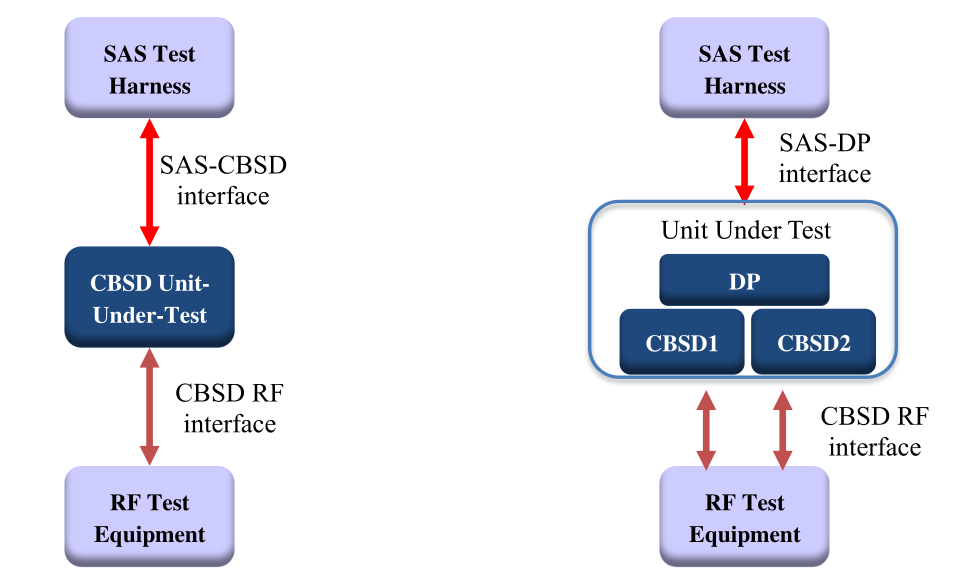
The following equipment is required to perform test cases in this document:
The following test equipment are required to test the UUT:
This includes any ancillary RF components (attenuators, cables, couplers, etc.) which may be required to perform those measurements.
The SAS Test Harness and RF measurement equipment shall be synchronized to UTC time.
The following are outside the scope of this document:
The unit-under-test shall provide functionality via a vendor-defined test interface, in order to support completion of all test cases in this document. The interface is outside the scope of this test document, but shall provide a minimum set of functionalities as described below:
UUT which supports more than one Air Interface according to [n.7] shall execute for each supported Air Interface the UUT RF Transmit Power Measurement test case (see Table 6-3 section 7.1.4.1.1). Based on UUT vendor implementation, other test cases in Table 6-3 may be necessary for each supported Air Interface.
This section includes all the test cases required for ensuring the SAS-CBSD/DP interface conforms to the specifications defined by WInnForum and directed by the requirements established by the FCC and DOD. The tables in this section identify and categorize the test cases for conformance testing.
Table 6-1 indicates the legend for test case classification in Table 6-3.
Table 6-1 Test Case Classification (for Table 6-3)
| Label | Description |
|---|---|
| M | Mandatory for certification |
| O | Optional. Not required for certification. |
| C | Conditional. Mandatory if CBSD supports relevant functionality. See Table 6-2 for definition of conditional notation. |
| D | Deprecated. Test no longer required for certification. |
Table 6-2 defines the applicability of conditional test cases listed in Table 6-3. Test cases marked as Conditional in Table 6-3 are mandatory for devices, as defined by the UUT vendor, according to the conditional definitions below.
Table 6-2 Conditional Test Case Definitions (for Table 6-3)
| Label | Description |
|---|---|
| C1 | Mandatory for UUT which supports multi-step registration message |
| C2 | Mandatory for UUT which supports single-step registration with no CPI-signed data in the registration message. By definition, this is a subset of Category A devices which determine all registration information, including location, without CPI intervention. |
| C3 | Mandatory for UUT which supports single-step registration containing CPI- signed data in the registration message. |
| C4 | Mandatory for UUT which supports RECEIVED_POWER_WITHOUT_GRANT measurement report type. |
| C5 | Mandatory for UUT which supports RECEIVED_POWER_WITH_GRANT measurement report type. |
| C6 | Mandatory for UUT which supports parameter change being made at the UUT and prior to sending a deregistration. |
Table 6-3 lists all test cases in this document, with indication of certification status (M/O/C – see Table 6-1), conditionality of test case, where appropriate (see Table 6-2), and applicability to CBSD or Domain Proxy (DP). Specifically:
Table 6-3 Test Case List
| Section | CBS D | DP | Require d for Cert. | Test Case ID | Test Case Title |
|---|---|---|---|---|---|
| 6.1.4.1.1 | X | -- | C1 | WINNF.FT.C.REG.1 | Multi-Step registration |
| 6.1.4.1.2 | -- | X | C1 | WINNF.FT.D.REG.2 | Domain Proxy Multi-Step registration |
| 6.1.4.1.3 | X | -- | C2 | WINNF.FT.C.REG.3 | Single-Step registration for Category A CBSD |
| 6.1.4.1.4 | -- | X | C2 | WINNF.FT.D.REG.4 | Domain Proxy Single-Step registration for Cat A CBSD |
| 6.1.4.1.5 | X | -- | C3 | WINNF.FT.C.REG.5 | Single-Step registration for CBSD with CPI signed data |
| 6.1.4.1.6 | -- | X | C3 | WINNF.FT.D.REG.6 | Domain Proxy Single-Step registration for CBSD with CPI signed data |
| 6.1.4.1.7 | X | X | C6 | WINNF.FT.C.REG.7 | Registration due to change of an installation parameter |
| 6.1.4.2.1 | X | -- | M | WINNF.FT.C.REG.8 | Missing Required parameters (responseCode 102) |
| 6.1.4.2.2 | -- | X | M | WINNF.FT.D.REG.9 | Domain Proxy Missing Required parameters (responseCode 102) |
| 6.1.4.2.3 | X | -- | M | WINNF.FT.C.REG.10 | Pending registration (responseCode 200) |
| 6.1.4.2.4 | -- | X | M | WINNF.FT.D.REG.11 | Domain Proxy Pending registration (responseCode 200) |
| 6.1.4.2.5 | X | -- | M | WINNF.FT.C.REG.12 | Invalid parameter (responseCode 103) |
| 6.1.4.2.6 | -- | X | M | WINNF.FT.D.REG.13 | Domain Proxy Invalid parameters (responseCode 103) |
| 6.1.4.2.7 | X | -- | M | WINNF.FT.C.REG.14 | Blacklisted CBSD (responseCode 101) |
| 6.1.4.2.8 | -- | X | M | WINNF.FT.D.REG.15 | Domain Proxy Blacklisted CBSD (responseCode 101) |
| 6.1.4.2.9 | X | -- | M | WINNF.FT.C.REG.16 | Unsupported SAS protocol version (responseCode 100) |
| 6.1.4.2.10 | -- | X | M | WINNF.FT.D.REG.17 | Domain Proxy Unsupported SAS protocol version responseCode 100) |
| 6.1.4.2.11 | X | -- | M | WINNF.FT.C.REG.18 | Group Error (responseCode 201) |
| 6.1.4.2.12 | -- | X | M | WINNF.FT.D.REG.19 | Domain Proxy Group Error (responseCode 201) |
| 6.1.4.3.1 | X | X | C2 | WINNF.FT.C.REG.20 | Category A CBSD location update |
| 6.3.4.2.1 | X | X | M | WINNF.FT.C.GRA.1 | Unsuccessful Grant responseCode=400 (INTERFERENCE) |
| 6.3.4.2.2 | X | X | M | WINNF.FT.C.GRA.2 | Unsuccessful Grant responseCode=401 (GRANT_CONFLICT) |
| 6.4.4.1.1 | X | -- | M | WINNF.FT.C.HBT.1 | Heartbeat Success Case (first Heartbeat Response) |
| 6.4.4.1.2 | -- | X | M | WINNF.FT.D.HBT.2 | Domain Proxy Heartbeat Success Case (first Heartbeat Response) |
| 6.4.4.2.1 | X | X | M | WINNF.FT.C.HBT.3 | Heartbeat responseCode=105 (DEREGISTER) |
| 6.4.4.2.2 | X | -- | M | WINNF.FT.C.HBT.4 | Heartbeat responseCode=500 (TERMINATED_GRANT) |
| 6.4.4.2.3 | X | X | M | WINNF.FT.C.HBT.5 | Heartbeat responseCode=501 (SUSPENDED_GRANT) in First Heartbeat Response |
| 6.4.4.2.4 | X | X | M | WINNF.FT.C.HBT.6 | Heartbeat responseCode=501 (SUSPENDED_GRANT) in Subsequent Heartbeat Response |
| 6.4.4.2.5 | X | X | M | WINNF.FT.C.HBT.7 | Heartbeat responseCode=502 (UNSYNC_OP_PARAM) |
| 6.4.4.2.6 | -- | X | M | WINNF.FT.D.HBT.8 | Domain Proxy Heartbeat responseCode=500 (TEMINATED_GRANT) |
| 6.4.4.3.1 | X | X | M | WINNF.FT.C.HBT.9 | Heartbeat Response Absent (First Heartbeat) |
| 6.4.4.3.2 | X | X | M | WINNF.FT.C.HBT.10 | Heartbeat Response Absent (Subsequent Heartbeat) |
| 6.4.4.4.1 | X | X | O | WINNF.FT.C.HBT.11 | Successful Grant Renewal in Heartbeat Test Case |
| 6.5.4.2.1 | X | -- | C4 | WINNF.FT.C.MES.1 | Registration Response contains measReportConfig |
| 6.5.4.2.2 | -- | X | C4 | WINNF.FT.D.MES.2 | Domain Proxy Registration Response contains measReportConfig |
| 6.5.4.2.3 | X | X | C5 | WINNF.FT.C.MES.3 | Grant Response contains measReportConfig |
| 6.5.4.2.4 | X | -- | C5 | WINNF.FT.C.MES.4 | Heartbeat Response contains measReportConfig |
| 6.5.4.2.5 | -- | X | C5 | WINNF.FT.D.MES.5 | Domain Proxy Heartbeat Response contains measReportConfig |
| 6.6.4.1.1 | X | -- | M | WINNF.FT.C.RLQ.1 | Successful Relinquishment |
| 6.6.4.1.2 | -- | X | M | WINNF.FT.D.RLQ.2 | Domain Proxy Successful Relinquishment |
| 6.6.4.2.1 | X | -- | O | WINNF.FT.C.RLQ.3 | Unsuccessful Relinquishment, responseCode=102 |
| 6.6.4.2.2 | -- | X | O | WINNF.FT.D.RLQ.4 | Domain Proxy Unsuccessful Relinquishment, responseCode=102 |
| 6.6.4.3.1 | X | -- | O | WINNF.FT.C.RLQ.5 | Unsuccessful Relinquishment, responseCode=103 |
| 6.6.4.3.2 | -- | X | O | WINNF.FT.D.RLQ.6 | Domain Proxy Unsuccessful Relinquishment, responseCode=103 |
| 6.7.4.1.1 | X | -- | M | WINNF.FT.C.DRG.1 | Successful Deregistration |
| 6.7.4.1.2 | -- | X | M | WINNF.FT.D.DRG.2 | Domain Proxy Successful Deregistration |
| 6.7.4.2.1 | X | -- | O | WINNF.FT.C.DRG.3 | Deregistration responseCode=102 |
| 6.7.4.2.2 | -- | X | O | WINNF.FT.D.DRG.4 | Domain Proxy Deregistration responseCode=102 |
| 6.7.4.3.1 | X | X | O | WINNF.FT.C.DRG.5 | Deregistration responseCode=103 |
| 6.8.4.1.1 | X | X | M | WINNF.FT.C.SCS.1 | Successful TLS connection between UUT and SAS Test Harness |
| 6.8.4.2.1 | X | X | M | WINNF.FT.C.SCS.2 | TLS failure due to revoked certificate |
| 6.8.4.2.2 | X | X | M | WINNF.FT.C.SCS.3 | TLS failure due to expired server certificate |
| 6.8.4.2.3 | X | X | M | WINNF.FT.C.SCS.4 | TLS failure when SAS Test Harness certificate is issue by unknown CA |
| 6.8.4.2.4 | X | X | M | WINNF.FT.C.SCS.5 | TLS failure when certificate at the SAS Test Harness is corrupted |
| 7.1.4.1.1 | X | X | M | WINNF.PT.C.HBT.1 | UUT RF Transmit Power Measurement |
This section provides test steps, conditions and procedures to test the conformance of the CBSD implementation for the CBSD Registration Procedure. A precondition is the CBSD has successfully discovered the SAS it wants to register with.
Each test generates a CBSD registration request and validates the CBSD takes the appropriate action following the SAS registration response, covering all the defined responseCodes available that pertain to the CBSD registration process in [n.5]. This includes successful registration as well, which is signified by responseCode 0.
Table 6-4 CBSD Registration Process Test Characteristics
| 1 | Test ID | WINNF.FT.C.REG |
|---|---|---|
| 2 | Title | CBSD Registration Process |
| 3 | Working Group / Entity | WG3 |
| 4 | Test Type | Functionality |
| 5 | Test Class | Certification |
| 6 | Component / Interface | CBSD / CBSD → SAS |
| 7 | Target Specification | [n.5], sections 8.3, 10.1, and 10.2 |
In summary, the CBSD parameters used for the registration process are categorized into the following [n.5]:
Required REG-Conditional Optional
When the location and other installation parameters are reported by the CBSD, and are included in the registration message. Information may be determined solely by the CBSD, or by CPI uploading the data into the CBSD. When the location and other installation parameters are uploaded offline by a professional installer.
Note: In this Section, "Multi-Step Registration" refers to the Registration process where the REG-conditional parameters are not included in the "RegistrationRequest Object". "Single-Step Registration" refers to the Registration process where the conditional parameters are included in the "RegistrationRequest Object". A CBSD vendor may support one or more of these registration methods. Test cases apply according to the type of registration process(es) supported by the CBSD under test.
If a CBSD has a valid FCC-ID, the assumption is the measurement capability shall be included in the Registration Request. The CBSD vendor may ask the FCC for a waiver to the measurement capability. The Single-Step registration test cases assume there is no waiver and therefore the test case will fail if the measurement capability is not provided.
The commercial SAS shall not reject a CBSD Registration request due to the fact the CBSD has left the measurement capability empty. If a waiver has been obtained for the UUT, a similar test case shall be executed that is not requiring a measurement capability be supplied in the registration message. Since this is based on obtaining an FCC waiver, the waiver specific test cases are not listed in Table 6-3.
The following two rules shall also be applied for a Single-Step registration for CBSD with CPI signed data.
If the installationParam object is provided outside of cpiSignedData, the Registration request shall be rejected. The installationParam object shall be provided inside the cpiSignedData and shall include all of its REG-Conditional parameters. If incomplete, the Registration request shall be rejected.
Upon a successful response from the SAS (responseCode = 0), the CBSD will generate its next message to the SAS. The SAS Test Harness when configured for verification of a particular CBSD-SAS protocol procedure (i.e. registration), will / may not respond to any subsequent messages sent by CBSD once the procedure being tested is complete.
This test is mandatory for CBSD which supports multi-step registration. This test validates that each of the required parameters appear within the registration request message. The following are the test execution steps:
| # | Test Execution Steps | Results | |
|---|---|---|---|
| 1 | Ensure the following conditions are met for test entry: UUT has successfully completed SAS Discovery and Authentication with the SAS Test Harness UUT is in the Unregistered state | -- | -- |
| 2 | CBSD sends correct Registration request information, as specified in [n.5], to the SAS Test Harness: The required userId, fccId and cbsdSerialNumber registration parameters shall be sent from the CBSD and conform to proper format and acceptable ranges. Any REG-conditional or optional registration parameters that may be included in the message shall be verified that they conform to proper format and are within acceptable ranges. Note: It is outside the scope of this document to test the Registration information that is supplied via another means. | PASS | FAIL |
| 3 | SAS Test Harness sends a CBSD Registration Response as follows: | -- | -- |
| - cbsdId = C - measReportConfig shall not be included - responseCode = 0 | |||
| 4 | After completion of step 3, SAS Test Harness will not provide any positive response ( responseCode =0) to further request messages from the UUT. | -- | -- |
| 5 | Monitor the RF output of the UUT from start of test until 60 seconds after Step 3 is complete. This is the end of the test. Verify: UUT shall not transmit RF | PASS | FAIL |
This test is mandatory for the Domain proxy that is controlling CBSDs which support multi-step registration. This test validates that each of the required parameters appear within the registration request message. This test case applies to Domain Proxy supervising two CBSDs. The following are the test execution steps:
| # | Test Execution Steps | Results | |
|---|---|---|---|
| 1 | Ensure the following conditions are met for test entry: UUT has successfully completed SAS Discovery and Authentication with SAS Test Harness UUT is in the Unregistered state | -- | -- |
| 2 | DP with two CBSD sends correct Registration request information, as specified in [n.5], in the form of one 2-element Array or as individual messages to the SAS Test Harness: The required userId, fccId and cbsdSerialNumber registration parameters shall be sent for each CBSD and conform to proper format and acceptable ranges. Any REG-conditional or optional registration parameters that may be included in the message shall be verified that they conform to proper format and are within acceptable ranges. Note: It is outside the scope of this document to test the Registration information that is supplied via another means. | PASS | FAIL |
| 3 | SAS Test Harness sends a CBSD Registration Response in the form of one 2-element Array or individual messages as follows: − cbsdId = Ci − measReportConfig shall not be included − responseCode = 0 for each CBSD | -- | -- |
| 4 | After completion of step 3, SAS Test Harness will not provide any positive response (responseCode=0) to further request messages from the UUT. | -- | -- |
| 5 | Monitor the RF output of each UUT from start of test until 60 seconds after Step 3 is complete. This is the end of the test. Verify: | PASS | FAIL |
This test is mandatory for CBSD which reports all Required and REG-Conditional parameters in the Registration request to the SAS, without CPI signed data. This test validates that each of the required and REG-Conditional parameters appear within the registration request message.
For a Category A CBSD which determine its own location, the test lab and vendor must agree on the required evidence showing the UUT meets the location requirement. In lieu of location verification, the vendor shall supply their test approach/procedure along with compliance data.
The following are the test execution steps:
| # | Test Execution Steps | Expected Results | Actual Results |
|---|---|---|---|
| 1 | Ensure the following conditions are met for test entry: • UUT has successfully completed SAS Discovery and Authentication with SAS Test Harness • UUT is in the Unregistered state | — | — |
| 2 | CBSD sends Registration request to SAS Test Harness: all required and REG-Conditional parameters included (userId, fccId, cbsdSerialNumber, cbsdCategory, airInterface, installationParam, measCapability) for a Category A CBSD. The required userId, fccId and cbsdSerialNumber and REG-Conditional cbsdCategory, airInterface, installationParam, and measCapability registration parameters shall be sent from the CBSD and conform to proper format and acceptable ranges. Any optional registration parameters that may be included in the message shall be verified that they conform to proper format and are within acceptable ranges. | — | PASS / FAIL |
| 3 | SAS Test Harness sends a CBSD Registration Response as follows: • cbsdId = C • measReportConfig shall not be included. • responseCode = 0 | — | — |
| 4 | After completion of step 3, SAS Test Harness will not provide any positive response (responseCode=0) to further request messages from the UUT. | — | — |
| 5 | Monitor the RF output of the UUT from start of test until 60 seconds after Step 3 is complete. This is the end of the test. Verify: UUT shall not transmit RF | PASS | FAIL |
If a waiver for the measurement capability has been obtained from the FCC for the CBSD, the WINNF.FT.C.REG.3_waiver test case shall be executed which is the same as above, but where measCapability is not required in the request message.
This test is mandatory for DP connected to CBSDs which report all Required and REG-Conditional parameters in the Registration request to the SAS, without CPI signed data. This test validates that each of the required and REG-Conditional parameters appear within the registration request message. This test case applies to Domain Proxy supervising two CBSDs.
For a Category A CBSD which determine own location, the test lab and vendor must agree on the required evidence showing the UUT meets the location requirement. In lieu of location verification, the vendor shall supply their test approach/procedure along with compliance data.
The following are the test execution steps:
| # | Test Execution Steps | Results | |
|---|---|---|---|
| 1 | Ensure the following conditions are met for test entry: UUT has successfully completed SAS Discovery and Authentication with SAS Test Harness UUT is in the Unregistered state | ||
| 2 | The DP with two CBSDs sends Registration requests in the form of one 2-element Array or as individual messages to SAS Test Harness. The required userId, fccId and cbsdSerialNumber and REG- Conditional cbsdCategory, airInterface, installationParam, and measCapability registration parameters shall be sent from the CBSD and conform to proper format and acceptable ranges. Any optional registration parameters that may be included in the message shall be verified that they conform to proper format and are within acceptable ranges. | PASS | FAIL |
| 3 | SAS Test Harness sends a CBSD Registration Response in the form of one 2-element Array or individual messages as follows: − cbsdId = Ci. − measReportConfig for each CBSD shall not be included. − responseCode = 0 for each CBSD | ||
| 4 | After completion of step 3, SAS Test Harness will not provide any positive response (responseCode=0) to further request messages from the UUT. | ||
| 5 | Monitor the RF output of each UUT from start of test until 60 seconds after Step 3 is complete. This is the end of the test. Verify: UUT shall not transmit RF | PASS | FAIL |
If a waiver for the measurement capability has been obtained from the FCC for the CBSD, the WINNF.FT.D.REG.4_waiver test case shall be executed which is the same as above, but where measCapability is not required in the request message.
This test is mandatory for CBSD which reports all Required and REG-Conditional parameters in the Registration request to the SAS using CPI signed data. This test validates that each of the required and REG-Conditional parameters appear within the registration request message.
All Category B devices, and Category A devices not able to determine its own location require installation by a CPI. This test is for devices where the CPI enters data into the CBSD and this information along with the CPI signature are sent in the request message. Excluded from this test are devices which require the CPI to enter the information into a SAS interface. These devices would use the multiple step registration test [WINNF.FT.C.REG.1].
The following are the test execution steps:
| # | Test Execution Steps | Results | |
|---|---|---|---|
| 1 | Ensure the following conditions are met for test entry: UUT has successfully completed SAS Discovery and Authentication with SAS Test Harness UUT is in the Unregistered state All of the required and REG-Conditional parameters shall be configured and CPI signature provided | -- | -- |
| 2 | CBSD sends Registration request to the SAS Test Harness: The required userId, fccId and cbsdSerialNumber and REG- Conditional cbsdCategory, airInterface, measCapability and cpiSignatureData registration parameters shall be sent from the CBSD and conform to proper format and acceptable ranges. Any optional registration parameters that may be included in the message shall be verified that they conform to proper format and are within acceptable ranges. | PASS | FAIL |
| 3 | SAS Test Harness sends a CBSD Registration Response as follows: − cbsdId = C − measReportConfig shall not be included. − responseCode = 0 | -- | -- |
| 4 | After completion of step 3, SAS Test Harness will not provide any positive response ( responseCode =0) to further request messages from the UUT. | -- | -- |
| 5 | Monitor the RF output of the UUT from start of test until 60 seconds after Step 3 is complete. This is the end of the test. Verify: UUT shall not transmit RF | PASS | FAIL |
If a waiver for the measurement capability has been obtained from the FCC for the CBSD, the WINNF.FT.C.REG.5_waiver test case shall be executed which is the same as above, but where measCapability is not required in the request message.
This test is mandatory for DP with CBSDs which report all Required and REG-Conditional parameters in the Registration request to the SAS using CPI signed data. This test validates that each of the required and REG-Conditional parameters appear within the registration request message. This test case applies to Domain Proxy supervising two CBSDs.
All Category B devices, and Category A devices not able to determine its own location require installation by a CPI. This test is for devices where the CPI enters data into the CBSD and this information along with the CPI signature are sent in the request message. Excluded from this test are devices which require the CPI to enter the information into a SAS interface. These devices would follow the multiple step registration test [WINNF.FT.D.REG.2].
| # | Test Execution Steps | Results | |
|---|---|---|---|
| 1 | Ensure the following conditions are met for test entry: UUT has successfully completed SAS Discovery and Authentication with SAS Test Harness UUT is in the Unregistered state All of the required and REG-Conditional parameters shall be configured and CPI signature provided | -- | -- |
| 2 | The DP with two CBSDs sends Registration requests in the form of one 2-element Array or as individual messages to the SAS Test Harness: The required userId, fccId and cbsdSerialNumber and REG- Conditional cbsdCategory, airInterface, measCapability and cpiSignatureData registration parameters shall be sent from the CBSD and conform to proper format and acceptable ranges. Any optional registration parameters that may be included in the message shall be verified that they conform to proper format and are within acceptable ranges. | PASS | FAIL |
| 3 | SAS Test Harness sends a CBSD Registration Response in the form of one 2-element Array or as individual messages as follows: − cbsdId = Ci − measReportConfig for each CBSD shall not be included. − responseCode = 0 for each CBSD | -- | -- |
| 4 | After completion of step 3, SAS Test Harness will not provide any positive response (responseCode=0) to further request messages from the UUT. | -- | -- |
| 5 | Monitor the RF output of each UUT from start of test until 60 seconds after Step 3 is complete. This is the end of the test. Verify: UUT shall not transmit RF | PASS | FAIL |
If a waiver for the measurement capability has been obtained from the FCC for the CBSD, the WINNF.FT.D.REG.6_waiver test case shall be executed which is the same as above, but where measCapability is not required in the request message.
The purpose of this test is to verify the CBSD sends notification to the SAS when an installation parameter has been changed.
This test is limited to CBSDs that support a registration parameter change/update to be made at the CBSD.
Further, this test only applies to CBSD devices that allow a registration parameter change to be made prior to sending a deregistration.
This test is not valid for CBSDs requiring a deregistration prior to allowing a parameter change to be made (for example, (i) bring CBSD out of service (deregister), (ii) change registration parameter, (iii) bring CBSD back into service (register)). Refer to the deregistration test case [WINNF.FT.C.DRG.1].
This test is also not valid for CBSDs which require registration parameter updates to be made directly into the SAS via a SAS interface.
The following are the test execution steps:
| # | Test Execution Steps | Results | |
|---|---|---|---|
| 1 | Ensure the following conditions are met for test entry: UUT has successfully completed SAS Discovery and Authentication with SAS Test Harness | -- | -- |
| 2 | UUT has successfully registered with SAS Test Harness | -- | -- |
| 3 | Change an installation parameters at the UUT (time T) Tester needs to record the current time at which the parameter change is executed. | -- | -- |
| 4 | Monitor the SAS-CBSD interface. UUT sends a deregistrationRequest to the SAS Test Harness The deregistration request shall be sent within (T + 60 seconds) from step 3. | PASS | FAIL |
CBSD under test cannot be expected to generate a message with a missing or invalid parameter. To test for responseCode not equal to 0, the SAS Test Harness will respond to a valid registrationRequest message with a registrationResponse with a non-zero responseCode.
The purpose of these tests is to ensure that the CBSD does not transmit when a responseCode other than 0 is received. The information sent in the registration request message is not important, only that it shall conform to the protocol.
Missing/Invalid response codes are tested by injecting those responseCodes into the SAS Test Harness generated response message, even though the UUT has sent a valid message
6.1.4.2.1 [WINNF.FT.C.REG.8] Missing Required parameters (responseCode 102)
The following are the test execution steps where the Registration response contains responseCode (R) = 102:
| # | Test Execution Steps | Results |
|---|---|---|
| 1 | Ensure the following conditions are met for test entry: UUT has successfully completed SAS Discovery and Authentication with SAS Test Harness UUT is in the Unregistered state | -- |
| 2 | CBSD sends a Registration request to SAS Test Harness. | -- |
| 3 | SAS Test Harness rejects the request by sending a CBSD Registration Response as follows: - SAS response does not include cbsdId - responseCode = R | -- |
| 4 | After completion of step 3, SAS Test Harness will not provide any positive response (responseCode=0) to further request messages from the UUT. | -- |
| 5 | Monitor the RF output of the UUT from start of test until 60 seconds after Step 3 is complete. This is the end of the test. Verify: UUT shall not transmit RF | PASS FAIL |
This test case applies to Domain Proxy supervising two CBSDs. The following are the test execution steps where the Registration response contains responseCode (Ri) = 102 for each CBSD:
| # | Test Execution Steps | Results | |
|---|---|---|---|
| 1 | Ensure the following conditions are met for test entry: UUT has successfully completed SAS Discovery and Authentication with SAS Test Harness UUT is in the Unregistered state | -- | -- |
| 2 | The DP with two CBSDs sends a Registration request in the form of one 2-element Array or as individual messages to SAS Test Harness. | -- | -- |
| 3 | SAS Test Harness sends a CBSD Registration Response in the form of one 2-element Array or as individual messages as follows: - SAS response does not include a cbsdId. - responseCode = Ri for CBSD1 and CBSD2 | -- | -- |
| 4 | After completion of step 3, SAS Test Harness will not provide any positive response (responseCode=0) to further request messages from the UUT. | -- | -- |
| 5 | Monitor the RF output of each UUT from start of test until 60 seconds after Step 3 is complete. This is the end of the test. Verify: UUT shall not transmit RF | PASS | FAIL |
The same steps provided for WINNF.FT.C.REG.8 shall be executed for this test, with the exception that the Registration response contains responseCode (R) = 200.
The same steps provided for WINNF.FT.D.REG.9 shall be executed for this test, with the exception that the Registration response contains responseCode (Ri) = 200 for each CBSD.
The same steps provided for WINNF.FT.C.REG.8 shall be executed for this test, with the exception that the Registration response contains responseCode (R) = 103.
The same steps provided for WINNF.FT.D.REG.9 shall be executed for this test, with the exception that the Registration response contains responseCode R1 = 0 for CBSD1 and R2 = 103 for CBSD2.
The same steps provided for WINNF.FT.C.REG.8 shall be executed for this test, with the exception that the Registration response contains responseCode (R) = 101.
The same steps provided for WINNF.FT.D.REG.9 shall be executed for this test, with the exception that the Registration response contains responseCode R1 = 0 for CBSD1 and R2 = 101 for CBSD2.
6.1.4.2.9 [WINNF.FT.C.REG.16] Unsupported SAS protocol version (responseCode 100)
The same steps provided for WINNF.FT.C.REG.8 shall be executed for this test, with the exception that the Registration response contains responseCode (R) = 100.
6.1.4.2.10 [WINNF.FT.D.REG.17] Domain Proxy Unsupported SAS protocol version (responseCode 100)
The same steps provided for WINNF.FT.D.REG.9 shall be executed for this test, with the exception that the Registration response contains responseCode (Ri) = 100 for each CBSD.
6.1.4.2.11 [WINNF.FT.C.REG.18] Group Error (responseCode 201)
The registrationRequest groupingParam is an optional field and will be validated by the SAS Test Harness if provided in the Registration Request message. This test will validate that the CBSD will remain Unregistered after receiving responseCode 201.
The same steps provided for WINNF.FT.C.REG.8 shall be executed for this test, with the exception that the Registration response contains responseCode (R) = 201.
6.1.4.2.12 [WINNF.FT.D.REG.19] Domain Proxy Group Error (responseCode 201)
The registrationRequest groupingParam is an optional field and will be validated by the SAS Test Harness if provided in the Registration Request message. This test will validate that the CBSD will remain Unregistered after receiving responseCode 201.
The same steps provided for WINNF.FT.D.REG.9 shall be executed for this test, with the exception that the Registration response contains responseCode R1 = 0 for CBSD1 and R2 = 201 for CBSD2.
This section is specific to Category A CBSDs that do not require professional installation. The requirement is for the Category A (non-professionally installed) to report to the SAS any location change exceeding a distance of 50m horizontally or 3m vertically within a 60 second window. It is left to the CBSD vendor and certification lab to generate the required evidence showing the UUT meets the requirement.
The test case ID is provided as a means to ensure that evidence is provided showing compliance to this requirement.
Spectrum Inquiry is an optional set of messages between the CBSD or DP/CBSD and SAS. If Spectrum Inquiry is used by the UUT, the specific Spectrum Inquiry test cases shall be executed.
This section provides test steps, condition and procedures to test the conformance of the CBSD implementation for the CBSD Spectrum Inquiry Procedure. It assumes as a precondition the CBSD has successfully discovered the SAS it wants to communicate with.
Each test generates a CBSD spectrum inquiry request and validatesthe CBSD takes the appropriate action following the SAS spectrum inquiry response.
Table 6-5 CBSD Spectrum Inquiry Process Test Characteristics
| 1 | Test ID | WINNF.FT.C.SIQ |
|---|---|---|
| 2 | Title | CBSD Spectrum Inquiry Process |
| 3 | Working Group / Entity | WG3 |
| 4 | Test Type | Functionality |
| 5 | Test Class | Certification |
| 6 | Component / Interface | CBSD / CBSD → SAS |
| 7 | Target Specification | [n.5], sections 8.4, 10.3, and 10.4 |
In all test cases under this category, the SpectrumInquiry Request is correct and valid. That is, the SAS Test Harness has checked that all the "Required" parameters are present in the SpectrumInquiry Request and their values are valid and correct. This part makes sure that CBSD is able to send correct and valid SpectrumInquiry Request.
This test case is incorporated into WINNF.FT.C.HBT.1, which validates successful Spectrum Inquiry messaging, if it is used by the UUT, as part of that test case.
6.2.4.1.2 Successful spectrum Inquiry response from SAS for all requests – Domain Proxy This test case is incorporated into WINNF.FT.D.HBT.2, which validates successful Spectrum Inquiry messaging, if it is used by the UUT, as part of that test case
This section provides test steps, condition and procedures to test the conformance of the CBSD implementation for the CBSD Spectrum Grant Procedure. A precondition is the CBSD has successfully discovered the SAS it wants to communicate with.
Each test generates a CBSD spectrum grant request and validates the CBSD takes the appropriate action following the SAS spectrum grant response.
Table 6-6 CBSD Spectrum Grant Process Test Characteristics
| 1 | Test ID | WINNF.FT.C.GRA |
|---|---|---|
| 2 | Title | CBSD Spectrum Grant Process |
| 3 | Working Group / Entity | WG3 |
| 4 | Test Type | Functionality |
| 5 | Test Class | Certification |
| 6 | Component / Interface | CBSD / CBSD ←→ SAS |
| 7 | Target Specification | [n.5], sections 8.5, 10.5, and 10.6 |
In all test cases under this category, the Grant Request is correct and valid. That is, the SAS Test Harness has checked that all the "Required" parameters are present in the Grant Request and their values are valid and correct. This part makes sure that CBSD is able to send correct and valid Grant Request.
This test case is incorporated into WINNF.FT.C.HBT.1, which validates successful Grant messaging as part of that test case.
This test case is incorporated into WINNF.FT.D.HBT.2, which validates successful Grant messaging as part of that test case.
The test cases in this section are for verifying the handling of CBSD for various responseCodes in response from the-SAS Test Harness.
The actions taken in response of any responseCode are beyond the scope of this document unless mentioned in the test procedure.
The following steps describe the test execution where the Grant response contains responseCode (R) = 400.
| # | Test Execution Steps | Results | |
|---|---|---|---|
| 1 | Ensure the following conditions are met for test entry: UUT has registered successfully with SAS Test Harness, with cbsdId = C | -- | -- |
| 2 | UUT sends valid Grant Request. | -- | -- |
| 3 | SAS Test Harness sends a Grant Response message, including cbsdId =C responseCode = R | -- | -- |
| 4 | After completion of step 3, SAS Test Harness will not provide any positive response ( responseCode =0) to further request messages from the UUT. | -- | -- |
| 5 | Monitor the RF output of the UUT from start of test until 60 seconds after Step 3 is complete. This is the end of the test. Verify: UUT shall not transmit RF | PASS | FAIL |
The same steps provided for WINNF.FT.C.GRA.1 shall be executed for this test, with the exception that the Grant response contains responseCode (R) = 401.
This section provides procedures for testing CBSD behavior during the Heartbeat Process. It assumes as precondition that CBSD has successfully discovered the SAS that it wants to register with, has successfully registered, has a successful Grant request, and is in the Granted or Authorized state.
Table 6-7 CBSD Heart Beat Process Test Characteristics
| 1 | Test ID | WINNF.FT.C.HBT | |
|---|---|---|---|
| 2 | Title | CBSD-SAS Heartbeat Process | |
| 3 | Working Group / Entity | WG3 | |
| 4 | Test Type | Functional (FT) | |
| 5 | Test Class | Certification | |
| 6 | Component / Interface | CBSD / CBSD → SAS | |
| 7 | Target Specification | [n.5], sections 8.6, 10.7, 10.8 | |
| # | Test Execution Steps | Results | |
| 1 | Ensure the following conditions are met for test entry: UUT has registered successfully with SAS Test Harness, with cbsdId = C | -- | -- |
| 2 | UUT sends a message: If message is type Spectrum Inquiry Request, go to step 3, or If message is type Grant Request, go to step 5 | -- | -- |
| 3 | UUT sends Spectrum Inquiry Request. Validate: cbsdId = C List of frequencyRange objects sent by UUT are within the CBRS frequency range | PASS | FAIL |
| 4 | SAS Test Harness sends a Spectrum Inquiry Response message, including the following parameters: cbsdId = C availableChannel is an array of availableChannel objects responseCode = 0 | -- | -- |
| 5 | UUT sends Grant Request message. Validate: cbsdId = C maxEIRP is at or below the limit appropriate for CBSD category as defined by Part 96 operationFrequencyRange , F, sent by UUT is a valid range within the CBRS band | PASS | FAIL |
| 6 | SAS Test Harness sends a Grant Response message, including the parameters: cbsdId = C grantId = G = a valid grant ID grantExpireTime = UTC time greater than duration of the test responseCode = 0 | -- | -- |
| 7 | UUT sends a first Heartbeat Request message. Verify Heartbeat Request message is formatted correctly, including: cbsdId = C grantId = G operationState = “GRANTED” | PASS | FAIL |
| 8 | SAS Test Harness sends a Heartbeat Response message, with the following parameters: cbsdId = C grantId = G | -- | -- |
| transmitExpireTime = current UTC time + 200 seconds responseCode = 0 | |||
| 9 | For further Heartbeat Request messages sent from UUT after completion of step 8, validate message is sent within latest specified heartbeatInterval, and: cbsdId = C grantId = G operationState = “AUTHORIZED” and SAS Test Harness responds with a Heartbeat Response message including the following parameters: cbsdId = C grantId = G transmitExpireTime = current UTC time + 200 seconds responseCode = 0 | PASS | FAIL |
| 10 | Monitor the RF output of the UUT from start of test until UUT transmission commences. Verify: UUT does not transmit at any time prior to completion of the first heartbeat response UUT transmits after step 8 is complete, and its transmission is limited to within the bandwidth range F. | PASS | FAIL |
Test case entry for all test cases includes:
The test cases in this section test the success path for the Heartbeat process. The SAS Test Harness shall use a heartBeatInterval of 60 seconds, unless specifically provided in the test case.
This test case incorporates validation of successful Spectrum Inquiry messaging (if present) and successful Grant messaging into the Heartbeat Success case.
This test case incorporates validation of successful Spectrum Inquiry messaging (if present) and successful Grant messaging into the Heartbeat Success case.
This test case applies to Domain Proxy supervising two CBSDs.
| # | Test Execution Steps | Results | |
|---|---|---|---|
| 1 | Ensure the following conditions are met for test entry: DP has two CBSD registered successfully with SAS Test Harness, with cbsdId = Ci, i={1,2} | -- -- | |
| 2 | DP sends a message: If message is a Spectrum Inquiry Request, go to step 3 If message is a Grant Request, go to step 5 | -- -- | |
| 3 | DP sends a Spectrum Inquiry Request message for each CBSD. This may occur in a separate message per CBSD, or together in a single message with array of 2. | PASS FAIL | |
| Verify Spectrum Inquiry Request message is formatted correctly for each CBSD, including for CBSDi, i={1,2}: cbsdId = Ci List of frequencyRange objects sent by DP are within the CBRS frequency range | |||
| 4 | If a separate Spectrum Inquiry Request message was sent for each CBSD, the SAS Test Harness shall respond to each Spectrum Inquiry Request message with a separate Spectrum Inquiry Response message. If a single Spectrum Inquiry Request message was sent containing a 2- object array (one per CBSD), the SAS Test Harness shall respond with a single Spectrum Inquiry Response message containing a 2-object array. Verify parameters for each CBSD within the Spectrum Inquiry Response message are as follows, for CBSDi, i={1,2}: cbsdId = Ci availableChannel is an array of availableChannel objects responseCode = 0 | -- | -- |
| 5 | DP sends a Grant Request message for each CBSD. This may occur in a separate message per CBSD, or together in a single message with array of 2. Verify Grant Request message is formatted correctly for each CBSD, including for CBSDi, i={1,2}: cbsdId = C maxEIRP is at or below the limit appropriate for CBSD category as defined by Part 96 operationFrequencyRange , Fi, sent by UUT is a valid range within the CBRS band | PASS | FAIL |
| 6 | If a separate Grant Request message was sent for each CBSD, the SAS Test Harness shall respond to each Grant Request message with a separate Grant Response message. If a single Grant Request message was sent containing a 2-object array (one per CBSD), the SAS Test Harness shall respond with a single Grant Response message containing a 2-object array. Verify parameters for each CBSD within the Grant Response message are as follows, for CBSDi, i={1,2}: cbsdId = Ci grantId = Gi = a valid grant ID grantExpireTime = UTC time greater than duration of the test responseCode = 0 | -- | -- |
| 7 | Ensure DP sends first Heartbeat Request message for each CBSD. This may occur in a separate message per CBSD, or together in a single message with array of 2. Verify Heartbeat Request message is formatted correctly for each CBSD, including, for CBSDi i={1,2}: cbsdId = Ci, i={1,2} grantId = Gi, i={1,2} operationState = "GRANTED" | PASS | FAIL |
| 8 | If a separate Heartbeat Request message was sent for each CBSD by the DP, the SAS Test Harness shall respond to each Heartbeat Request message with a separate Heartbeat Response message. If a single Heartbeat Request message was sent by the DP containing a 2-object array (one per CBSD), the SAS Test Harness shall respond with a single Heartbeat Response message containing a 2-object array. Verify parameters for each CBSD within the Heartbeat Response message are as follows, for CBSDi: cbsdId = Ci grantId = Gi transmitExpireTime = current UTC time + 200 seconds responseCode = 0 | -- | -- |
| 9 | For further Heartbeat Request messages sent from DP after completion of step 8, validate message is sent within latest specified heartbeatInterval for CBSDi: cbsdId = Ci grantId = Gi operationState = “AUTHORIZED" and SAS Test Harness responds with a Heartbeat Response message including the following parameters, for CBSDi cbsdId = Ci grantId = Gi transmitExpireTime = current UTC time + 200 seconds responseCode = 0 | PASS | FAIL |
| 10 | Monitor the RF output of the UUT from start of test until UUT transmission commences. Monitor the RF output of the UUT from start of test until RF transmission commences. Verify: UUT does not transmit at any time prior to completion of the first heartbeat response UUT transmits after step 8 is complete, and its transmission is limited to within the bandwidth range Fi. | PASS | FAIL |
| 11 | Ensure the following conditions are met for test entry: UUT has registered successfully with SAS Test Harness UUT has a valid single grant as follows: valid cbsdId = C valid grantId = G grant is for frequency range F, power P grantExpireTime = UTC time greater than duration of the test UUT is in AUTHORIZED state and is transmitting within the grant bandwidth F on RF interface | -- | -- |
| 12 | UUT sends a Heartbeat Request message. Ensure Heartbeat Request message is sent within Heartbeat Interval specified in the latest Heartbeat Response, and formatted correctly, including: cbsdId = C grantId = G operationState = “AUTHORIZED” | PASS | FAIL |
| 13 | SAS Test Harness sends a Heartbeat Response message, including the following parameters: cbsdId = C grantId = G transmitExpireTime = T = Current UTC time responseCode = 105 (DEREGISTER) | -- | -- |
| 14 | After completion of step 3, SAS Test Harness shall not allow any further grants to the UUT. | -- | -- |
| 15 | Monitor the RF output of the UUT. Verify: UUT shall stop transmission within (T + 60 seconds) of completion of step 3 | PASS | FAIL |
The test cases in this section cover Heartbeat Response messages with non-zero responseCodes. Part of the pass/fail criteria of these test cases is the cessation of all UUT RF transmission. Therefore, in all test cases, after the non-zero responseCode is sent, the SAS Test Harness shall not allow any new Grant Request from the UUT to succeed.
The following are the test execution steps.
| # | Test Execution Steps | Results | |
|---|---|---|---|
| 1 | Ensure the following conditions are met for test entry: UUT has registered successfully with SAS Test Harness UUT has a valid single grant as follows: ○ valid cbsdId = C ○ valid grantId = G ○ grant is for frequency range F, power P ○ grantExpireTime = UTC time greater than duration of the test UUT is in AUTHORIZED state and is transmitting within the grant bandwidth F on RF interface | ||
| 2 | UUT sends a Heartbeat Request message. Ensure Heartbeat Request message is sent within latest specified heartbeatInterval, and is formatted correctly, including: cbsdId = C grantId = G operationState = “AUTHORIZED” | PASS | FAIL |
| 3 | SAS Test Harness sends a Heartbeat Response message, including the following parameters: cbsdId = C grantId = G transmitExpireTime = T = current UTC time responseCode = 500 (TERMINATED_GRANT) | ||
| 4 | After completion of step 3, SAS Test Harness shall not allow any further grants to the UUT. | ||
| 5 | Monitor the RF output of the UUT. Verify: UUT shall stop transmission within (T + 60 seconds) of completion of step 3 | PASS | FAIL |
| # | Test Execution Steps | Results |
|---|---|---|
| 1 | Ensure the following conditions are met for test entry: UUT has registered successfully with SAS Test Harness UUT has a valid single grant as follows: o valid cbsdId = C | -- |
| ○ valid grantId = G ○ grant is for frequency range F, power P ○ grantExpireTime = UTC time greater than duration of the test UUT is in GRANTED, but not AUTHORIZED state (i.e. has not performed its first Heartbeat Request) | ||
| 2 | UUT sends a Heartbeat Request message. Verify Heartbeat Request message is formatted correctly, including: cbsdId = C grantId = G operationState = “GRANTED” | PASS |
| 3 | SAS Test Harness sends a Heartbeat Response message, including the following parameters: cbsdId = C grantId = G transmitExpireTime = T = current UTC time responseCode = 501 (SUSPENDED_GRANT) | -- |
| 4 | After completion of step 3, SAS Test Harness shall not allow any further grants to the UUT. | -- |
| 5 | Monitor the SAS-CBSD interface. Verify either A OR B occurs: A. UUT sends a Heartbeat Request message. Ensure message is sent within latest specified heartbeatInterval, and is correctly formatted with parameters: cbsdId = C grantId = G operationState = "GRANTED" B. UUT sends a Relinquishment request message. Ensure message is correctly formatted with parameters: cbdsId = C grantId = G Monitor the RF output of the UUT. Verify: UUT does not transmit at any time | PASS |
| # | Test Execution Steps | Results |
|---|---|---|
| 1 | Ensure the following conditions are met for test entry: UUT has registered successfully with SAS Test Harness | -- -- |
| UUT has a valid single grant as follows: valid cbsdId = C valid grantId = G grant is for frequency range F, power P grantExpireTime = UTC time greater than duration of the test UUT is in AUTHORIZED state and is transmitting within the grant bandwidth F on RF interface | ||
| 2 | UUT sends a Heartbeat Request message. Verify Heartbeat Request message is sent within latest specified heartbeatInterval, and is formatted correctly, including: cbsdId = C grantId = G operationState = “AUTHORIZED” | PASS |
| 3 | SAS Test Harness sends a Heartbeat Response message, including the following parameters: cbsdId = C grantId = G transmitExpireTime = T = current UTC time responseCode = 501 (SUSPENDED_GRANT) | -- |
| 4 | After completion of step 3, SAS Test Harness shall not allow any further grants to the UUT. | -- |
| 5 | Monitor the SAS-CBSD interface. Verify either A OR B occurs: A. UUT sends a Heartbeat Request message. Ensure message is sent within latest specified heartbeatInterval, and is correctly formatted with parameters: cbsdId = C grantId = G operationState = "GRANTED" B. UUT sends a Relinquishment Request message. Ensure message is correctly formatted with parameters: cbdsId = C grantId = G Monitor the RF output of the UUT. Verify: UUT shall stop transmission within (T + 60 seconds) of completion of step 3 | PASS |
| # | Test Execution Steps | Results |
|---|---|---|
| 1 | Ensure the following conditions are met for test entry: UUT has registered successfully with SAS Test Harness UUT has a valid single grant as follows: o valid cbsdId = C o valid grantId = G o grant is for frequency range F, power P o grantExpireTime = UTC time greater than duration of the test UUT is in AUTHORIZED state and is transmitting within the grant bandwidth F on RF interface | -- |
| 2 | UUT sends a Heartbeat Request message. Verify Heartbeat Request message is sent within latest specified heartbeatInterval ,and is formatted correctly, including: cbsdId = C grantId = G operationState = “AUTHORIZED” | PASS |
| 3 | SAS Test Harness sends a Heartbeat Response message, including the following parameters: cbsdId = C grantId = G transmitExpireTime = T = Current UTC Time responseCode = 502 (UNSYNC_OP_PARAM) | -- |
| 4 | After completion of step 3, SAS Test Harness shall not allow any further grants to the UUT. | -- |
| 5 | Monitor the SAS-CBSD interface. Verify: UUT sends a Grant Relinquishment Request message. Verify message is correctly formatted with parameters: o cbdsId = C o grantId = G Monitor the RF output of the UUT. Verify: UUT shall stop transmission within (T+60) seconds of completion of step 3. | PASS |
This test case applies to Domain Proxy supervising two CBSDs.
| # | Test Execution Steps | Results | |
|---|---|---|---|
| 1 | Ensure the following conditions are met for test entry: | -- | |
| DP has two CBSD registered successfully with SAS Test Harness Each CBSD {1,2} has a valid single grant as follows: valid cbsdId = Ci, i={1,2} valid grantId = Gi, i={1,2} grant is for frequency range Fi, power Pi grantExpireTime = UTC time greater than duration of the test Both CBSD are in AUTHORIZED state and transmitting within their granted bandwidth on RF interface | |||
| 2 | DP sends a Heartbeat Request message for each CBSD. This may occur in a separate message per CBSD, or together in a single message with array of size 2. Verify Heartbeat Request message is sent within latest specified heartbeatInterval , and is formatted correctly for each CBSD, including, for CBSDi i={1,2}: cbsdId = Ci, i = {1,2} grantId = Gi, i = {1,2} operationState = “AUTHORIZED” | PASS | FAIL |
| 3 | If separate Heartbeat Request message was sent for each CBSD by the DP, the SAS Test Harness shall respond to each Heartbeat Request message with a separate Heartbeat Response message. If a single Heartbeat Request message was sent by the DP containing a 2-object array (one per CBSD), the SAS Test Harness shall respond with a single Heartbeat Response message containing a 2-object array. Parameters for each CBSD within the Heartbeat Response message should be as follows, for CBSDi: cbsdId = Ci grantId = Gi For CBSD1: transmitExpireTime = current UTC time + 200 seconds responseCode = 0 For CBSD2: transmitExpireTime = T = current UTC time responseCode = 500 (TERMINATED_GRANT) | -- | -- |
| 4 | After completion of step 3, SAS Test Harness shall not allow any further grants to the UUT. If CBSD sends further Heartbeat Request messages for CBSD1, SAS Test Harness shall respond with a Heartbeat Response message with parameters: | -- | -- |
| cbsdId = C1 grantId = G1 transmitExpireTime = current UTC time + 200 seconds responseCode = 0 Heartbeat Request message is within heartbeatInterval of previous Heartbeat Request message | |||
| 5 | Monitor the RF output of CBSD2. Verify: CBSD2 shall stop transmission within bandwidth F2 within (T + 60 seconds) of completion of step 3 | PASS | FAIL |
These test cases cover the case where communication is lost between the UUT and the SAS during the Heartbeat Process.
| # | Test Execution Steps | Results | |
|---|---|---|---|
| 1 | Ensure the following conditions are met for test entry: UUT has registered successfully with SAS Test Harness UUT has a valid single grant as follows: ○ valid cbsdId = C ○ valid grantId = G ○ grant is for frequency range F, power P ○ grantExpireTime = UTC time greater than duration of the test UUT is in GRANTED, but not AUTHORIZED state (i.e. has not performed its first Heartbeat Request) | -- | -- |
| 2 | UUT sends a Heartbeat Request message. Ensure Heartbeat Request message is sent within latest specified heartbeatInterval, and is formatted correctly, including: cbsdId = C grantId = G operationState = "GRANTED" | PASS | FAIL |
| 3 | After completion of Step 2, SAS Test Harness does not respond to any further messages from UUT to simulate loss of network connection | -- | -- |
| 4 | Monitor the RF output of the UUT from start of test to 60 seconds after step 3. Verify: | PASS | FAIL |
At any time during the test, UUT shall not transmit on RF interface
The following are the test execution steps.
| # | Test Execution Steps | Results | |
|---|---|---|---|
| 1 | Ensure the following conditions are met for test entry: UUT has registered successfully with SAS Test Harness UUT has a valid single grant as follows: valid cbsdId = C valid grantId = G grant is for frequency range F, power P grantExpireTime = UTC time greater than duration of the test UUT is in AUTHORIZED state and is transmitting within the grant bandwidth F on RF interface | -- | -- |
| 2 | UUT sends a Heartbeat Request message. Verify Heartbeat Request message is sent within the latest specified heartbeatInterval, and is formatted correctly, including: cbsdId = C grantId = G operationState = "AUTHORIZED" | PASS | FAIL |
| 3 | SAS Test Harness sends a Heartbeat Response message, with the following parameters: cbsdId = C grantId = G transmitExpireTime = current UTC time + 200 seconds responseCode = 0 | -- | -- |
| 4 | After completion of Step 3, SAS Test Harness does not respond to any further messages from UUT | -- | -- |
| 5 | Monitor the RF output of the UUT. Verify: UUT shall stop all transmission on RF interface within (transmitExpireTime + 60 seconds), using the transmitExpireTime sent in Step 3. | PASS | FAIL |
| 1 | Ensure the following conditions are met for test entry: UUT has registered successfully with SAS Test Harness UUT has a valid single grant as follows: valid cbsdId = C valid grantId = G grant is for frequency range F, power P UUT is in AUTHORIZED state and is transmitting within the grant bandwidth F on RF interface. Grant has the following parameters at the start of the test: grantExpireTime =UTC time equal to time at start of test + 300 seconds = Tgrant_expire transmitExpireTime = UTC time equal to time at start of test + 200 seconds heartbeatInterval = 60 seconds | -- | -- |
| 2 | UUT sends a Heartbeat Request message. If Heartbeat Request message contains grantRenew = TRUE, go to Step 6, else go to Step 3. | -- | -- |
| 3 | Verify Heartbeat Request message is sent within the latest specified heartbeatInterval, and is formatted correctly, including: cbsdId = C grantId = G operationState = “AUTHORIZED” | PASS | FAIL |
| 4 | SAS Test Harness sends a Heartbeat Response message, with the following parameters: cbsdId = C grantId = G transmitExpireTime = current UTC + 200 seconds grantExpireTime = same as Step 1 responseCode = 0 | -- | -- |
| 5 | Go to Step 2 | -- | -- |
| 6 | Verify Heartbeat Request message is sent within the latest specified heartbeatInterval, and is formatted correctly, including: cbsdId = C grantId = G operationState = “AUTHORIZED” grantRenew = TRUE | PASS | FAIL |
| 7 | SAS Test Harness sends a Heartbeat Response message, with the following parameters: | -- | -- |
| cbsdId = C grantId = G grantExpireTime = UTC time set far in the future transmitExpireTime = current UTC time + 200 seconds responseCode = 0 | |||
| 8 | Continue to respond to any subsequentHeartbeat Request from CBSD with Heartbeat Response with the following parameters: cbsdId = C grantId = G transmitExpireTime = same as Step 7 responseCode = 0 | -- | -- |
| 9 | Monitor RF transmission of UUT from start of test until Tgrant_expire + 60 seconds and ensure UUT continues to transmit throughout the time period. | PASS | FAIL |
Test cases in this section test Grant Renewal within the Heartbeat Process.
This section explains test steps/condition/procedure for CBSD behavior for Measurement Reports.
The main test cases for Measurement Report are outlined below, in terms of Measurement Report Stimulus (in a Response message from SAS) and a Measurement Report Response (in the subsequent Request message from the UUT).
Devices which support one measurement capability must satisfy the test cases mandatory for that measurement capability. Devices which support multiple measurement capabilities must satisfy the test cases mandatory for each type of supported measurement capability.
| Case | Stimulus (from SAS) | Response (from CBSD) | CBSD Capability | |
|---|---|---|---|---|
| WITHOUT_GRANT | WITH_GRANT | |||
| 1 | RegistrationResponse(measReportConfig) | Subsequent SpectrumInquiryRequest(measReport)* AND GrantRequest(measReport) | M | n/a |
| 2 | GrantResponse(measReportConfig) | Subsequent HeartbeatRequest(measReport) | n/a | M |
| 3 | HeartbeatResponse(measReportConfig) | Subsequent HeartbeatRequest(measReport) | n/a | M |
* Note: SpectrumInquiryRequest is an optional message. If present, measReport shall be in both SpectrumInquiryRequest and GrantRequest
The Measurement Report element enumerations, formats and acceptable values are described in [n.7].
Since there is no measurement accuracy requirement, Measurement Reports are tested for proper format, but not for reporting accuracy.
Table 6-8 CBSD Measurement Report Process Test Characteristics
| 1 | Test ID | WINNF.FT.C.MES |
|---|---|---|
| 2 | Title | CBSD-SAS Measurement Report |
| 3 | Working Group / Entity | WG3 |
| 4 | Test Type | Functionality |
| 5 | Test Class | Certification |
| 6 | Component / Interface | CBSD / CBSD → SAS |
| 6 | Target Specification | [n.5], sections 8.3, 8.4, 8.5, 8.6, [n.7] |
Test case entry for all test cases includes:
Test harness SAS Discovery and Authentication by CBSD is complete
Additional entry requirements are outlined in each test case.
** Indicates test is Mandatory (M) or n/a to UUT which supports RECEIVED_POWER_WITHOUT_GRANT or RECEIVED_POWER_WITH_GRANT
Test cases in this section test the proper reporting of Measurement Capability by the CBSD.
Testing of CBSD measurement capability (measCapability) reporting is done in the appropriate registration test case(s): WINNF.FT.C.REG.3, WINNF.FT.D.REG.4, WINNF.FT.REG.5, and WINNF.FT.D.REG.6.
Test cases in this section test the success path for each possible Measurement Report
This test case is mandatory for CBSD supporting RECEIVED_POWER_WITHOUT_GRANT.
| # | Test Execution Steps | Results | |
|---|---|---|---|
| 1 | Ensure the following conditions are met for test entry: UUT has successfully completed SAS Discovery and Authentication with SAS Test Harness | -- | -- |
| 2 | UUT sends a Registration Request message. Validate the Registration Request message is formatted correctly, including: userId is present and correct fccId is present and correct cbsdSerialNumber is present and correct measCapability = "RECEIVED_POWER_WITHOUT_GRANT" | PASS | FAIL |
| 3 | SAS Test Harness sends a Registration Response message, with the following parameters: cbsdId = C = valid cbsdId for this UUT measReportConfig= "RECEIVED_POWER_WITHOUT_GRANT" responseCode = 0 | -- | -- |
| 4 | UUT sends a message: | -- | -- |
| If message is type Spectrum Inquiry Request, go to step 5, or If message is type Grant Request, go to step 7 | |||
| 5 | UUT sends message type Spectrum Inquiry Request. Verify message contains all required parameters properly formatted, and specifically: cbsdId = C measReport is present, and is a properly formatted rcvdPowerMeasReport. | PASS | FAIL |
| 6 | SAS Test Harness sends a Spectrum Inquiry Response, with the following parameters: cbsdId = C availableChannel is an array of availableChannel objects responseCode = 0 | -- | -- |
| 7 | UUT sends message type Grant Request message. Verify message contains all required parameters properly formatted, and specifically: cbsdId = C measReport is present, and is a properly formatted rcvdPowerMeasReport. | PASS | FAIL |
This test case is mandatory for Domain Proxy supervising CBSD which support RECEIVED_POWER_WITHOUT_GRANT.
| # | Test Execution Steps | Results | |
|---|---|---|---|
| 1 | Ensure the following conditions are met for test entry: DP has successfully completed SAS Discovery and Authentication with SAS Test Harness | -- | -- |
| 2 | DP sends a Registration Request message for each of two CBSD. This may occur in a separate Request message per CBSD, or together in a single Request message with array of 2. Verify Registration Request message contains all required parameters properly formatted for CBSDi, i={1,2}, and specifically: userId is present and correct fccId is present and correct cbsdSerialNumber is present and correct measCapability = “RECEIVED_POWER_WITHOUT_GRANT” | PASS | FAIL |
| 3 | If a separate Registration Request message was sent for each CBSD by the DP, the SAS Test Harness shall respond to each Registration Request message with a separate Registration Response message. If a single Registration Request message was sent by the DP containing a 2-object array (one per CBSD), the SAS Test Harness shall respond with a single Registration Response message containing a 2-object array. Parameters for each CBSD within the Registration Response message should be as follows, for CBSDi: $cbsdId = Ci$ $measReportConfig=$ "RECEIVED_POWER_WITHOUT_GRANT" $responseCode = 0$ | ||
| 4 | UUT sends a message: If message is type Spectrum Inquiry Request, go to step 5, or If message is type Grant Request, go to step 7 | ||
| 5 | UUT sends message type Spectrum Inquiry Request. This may occur in a separate message per CBSD, or together in a single message with array of 2. Verify Spectrum Inquiry Request message contains all required parameters properly formatted for CBSDi, i= {1,2}, and specifically: $cbsdId = Ci$ $measReport$ is present, and is a properly formatted $rcvdPowerMeasReport$ . | PASS | FAIL |
| 6 | If a separate Spectrum Inquiry Request message was sent for each CBSD by the DP, the SAS Test Harness shall respond to each Spectrum Inquiry Request message with a separate Spectrum Inquiry Response message. If a single Spectrum Inquiry Request message was sent by the DP containing a 2-object array (one per CBSD), the SAS Test Harness shall respond with a single Spectrum Inquiry Response message containing a 2-object array. Parameters for each CBSD within the Spectrum Inquiry Response message should be as follows: $cbsdId = Ci$ $availableChannel$ is an array of $availableChannel$ objects $responseCode = 0$ | ||
| 7 | UUT sends message type Grant Request message. This may occur in a separate message per CBSD, or together in a single message with array of 2. Verify the Grant Request message contains all required parameters properly formatted for CBSDi, i= {1,2}, and specifically: | PASS | FAIL |
| cbsdId = Ci measReport is present, and is a properly formatted rcvdPowerMeasReport . |
This test case is mandatory for UUT supporting RECEIVED_POWER_WITH_GRANT measurement reports.
| # | Test Execution Steps | Results | |
|---|---|---|---|
| 1 | Ensure the following conditions are met for test entry: UUT has successfully completed SAS Discovery and Authentication with SAS Test Harness UUT has successfully registered with SAS Test Harness, with cbsdId=C and measCapability = "RECEIVED_POWER_WITH_GRANT" | -- | -- |
| 2 | UUT sends a Grant Request message. Verify Grant Request message contains all required parameters properly formatted, and specifically: cbsdId = C operationParam is present and format is valid | PASS | FAIL |
| 3 | SAS Test Harness sends a Grant Response message, with the following parameters: cbsdId = C grantId = G = valid grant ID grantExpireTime = UTC time in the future heartbeatInterval = 60 seconds measReportConfig= “RECEIVED_POWER_WITH_GRANT” channelType = “GAA” responseCode = 0 | -- | -- |
| 4 | UUT sends a Heartbeat Request message. Verify message contains all required parameters properly formatted, and specifically: cbsdId = C grantId = G | PASS | FAIL |
| operationState = “GRANTED” | |||
| 5 | If Heartbeat Request message (step 4) contains measReport object, then: verify measReport is properly formatted as object rcvdPowerMeasReport end test, with PASS result | PASS | FAIL |
| else, if Heartbeat Request message (step 4) does not contain measReport object, then: If number of Heartbeat Requests sent by UUT after Step 3 is = 5, then stop test with result of FAIL | |||
| 6 | SAS Test Harness sends a Heartbeat Response message, containing all required parameters properly formatted, and specifically: cbsdId = C grantId = G transmitExpireTime = current UTC time + 200 seconds responseCode = 0 | -- | -- |
| Go to Step 4, above |
This test case is mandatory for UUT supporting RECEIVED_POWER_WITH_GRANT measurement reports.
| # | Test Execution Steps | Results | |
|---|---|---|---|
| 1 | Ensure the following conditions are met for test entry: UUT has successfully completed SAS Discovery and Authentication with SAS Test Harness UUT has successfully registered with SAS Test Harness, with cbsdId =C and measCapability = "RECEIVED_POWER_WITH_GRANT” UUT has received a valid grant with grantId = G UUT is in Grant State AUTHORIZED and is actively transmitting within the bounds of its grant. Grant has heartbeatInterval = 60 seconds | -- | |
| 2 | UUT sends a Heartbeat Request message. Verify Heartbeat Request message contains all required parameters properly formatted, and specifically: cbsdId = C grantId = G | PASS | FAIL |
| operationState = “AUTHORIZED” | |||
| 3 | SAS Test Harness sends a Heartbeat Response message, containing all required parameters properly formatted, and specifically: cbsdId = C grantId = G measReportConfig= “RECEIVED_POWER_WITH_GRANT” responseCode = 0 | -- | -- |
| 4 | UUT sends a Heartbeat Request message. Verify message contains all required parameters properly formatted, and specifically: cbsdId = C grantId = G operationState = "AUTHORIZED" | PASS | FAIL |
| 5 | If Heartbeat Request message (step 4) contains measReport object, then: verify measReport is properly formatted as object rcvdPowerMeasReport end test, with PASS result else, if Heartbeat Request message (step 4) does not contain measReport object, then: If number of Heartbeat Requests sent by UUT after Step 3 is = 5, then stop test with result of FAIL | PASS | FAIL |
| 6 | SAS Test Harness sends a Heartbeat Response message, containing all required parameters properly formatted, and specifically: cbsdId = C grantId = G responseCode = 0 Go to Step 4. above | -- | -- |
This test case is mandatory for Domain Proxy supervising CBSD which support RECEIVED_POWER_WITH_GRANT measurement reports.
| # | Test Execution Steps | Results | |
|---|---|---|---|
| 1 | Ensure the following conditions are met for test entry: DP has successfully completed SAS Discovery and Authentication with SAS Test Harness | -- | -- |
| DP has successfully registered 2 CBSD with SAS Test Harness, each with cbsdId =Ci, i={1,2} and measCapability = "RECEIVED_POWER_WITH_GRANT” DP has received a valid grant with grantId = Gi, i={1,2} for each CBSD Both CBSD are in Grant State AUTHORIZED and actively transmitting within the bounds of their grants. Grants have heartbeatInterval =60 seconds | |||
| 2 | Verify DP sends a Heartbeat Request message for each CBSD. This may occur in a separate message per CBSD, or together in a single message with array of 2. Verify Heartbeat Request message contains all required parameters properly formatted for each CBSD, specifically, for CBSDi: cbsdId = Ci grantId = Gi operationState = “AUTHORIZED” | PASS | FAIL |
| 3 | If a separate Heartbeat Request message was sent for each CBSD by the DP, the SAS Test Harness shall respond to each Heartbeat Request message with a separate Heartbeat Response message. If a single Heartbeat Request message was sent by the DP containing a 2-object array (one per CBSD), the SAS Test Harness shall respond with a single Heartbeat Response message containing a 2-object array. Parameters for each CBSD within the Heartbeat Response message containing all required parameters properly formatted, and specifically: cbsdId = Ci grantId = Gi measReportConfig = “RECEIVED_POWER_WITH_GRANT” responseCode = 0 | -- | -- |
| 4 | Verify DP sends a Heartbeat Request message for each CBSD. This may occur in a separate message per CBSD, or together in a single message with array of 2. Verify Heartbeat Request message contains all required parameters properly formatted for each CBSD, and specifically, for CBSDi, i = {1,2}: cbsdId = Ci grantId = Gi operationState = “AUTHORIZED” Check whether measReport is present, and if present, ensure it is a properly formatted rcvdPowerMeasReport object, and record its reception for each CBSDi, i = {1,2}. | PASS | FAIL |
| 5 | If Heartbeat Request message (step 4) contains measReport object, then: Verify measReport is properly formatted as object rcvdPowerMeasReport record which CBSD have successfully sent a measReport object | PASS | FAIL |
| If all CBSDi, i = {1,2} have successfully sent a measReport object, then end test, with PASS result else, if the number of Heartbeat Requests sent per CBSD is 5 or more, then stop test with result of FAIL | |||
| If a separate Heartbeat Request message was sent for each CBSD by the DP, the SAS Test Harness shall respond to each Heartbeat Request message with a separate Heartbeat Response message. | |||
| If a single Heartbeat Request message was sent by the DP containing a 2-object array (one per CBSD), the SAS Test Harness shall respond with a single Heartbeat Response message containing a 2-object array. | |||
| 6 | Parameters for each CBSD within the Heartbeat Response message containing all required parameters properly formatted, and specifically: cbsdId = Ci grantId = Gi responseCode = 0 Go to Step 4, above. |
This section provides test steps, condition and procedures to test the conformance of the CBSD implementation for the CBSD Relinquishment Procedure. A precondition is the CBSD has successfully discovered the SAS it wants to communicate with.
Each test generates a CBSD relinquishment request and validates the CBSD takes the appropriate action following the SAS relinquishment response. The CBSD shall send the Relinquishment request message after stopping the RF transmission.
| 1 | Test ID | WINNF.FT.C.RLQ |
|---|---|---|
| 2 | Title | CBSD-SAS Relinquishment Process |
| 3 | Working Group / Entity | WG3 |
| 4 | Test Type | Functionality |
| 5 | Test Class | Certification |
| 6 | Component / Interface | CBSD / CBSD SAS |
| 7 | Target Specification | [n.5], sections 8.7, 10.9 and 10.10 |
| # | Test Execution Steps | Results |
|---|---|---|
| 1 | Ensure the following conditions are met for test entry: UUT has successfully completed SAS Discovery and Authentication with SAS Test Harness UUT has successfully registered with SAS Test Harness, with cbsdId =C UUT has received a valid grant with grantId = G UUT is in Grant State AUTHORIZED and is actively transmitting within the bounds of its grant. Invoke trigger to relinquish UUT Grant from the SAS Test Harness | -- |
| 2 | UUT sends a Relinquishment Request message. Verify message contains all required parameters properly formatted, and specifically: cbsdId = C grantId = G | PASS |
| 3 | SAS Test Harness shall approve the request with a Relinquishment Response message with parameters: - cbsdId = C - grantId = G - responseCode = 0 | -- |
| 4 | After completion of step 3, SAS Test Harness will not provide any additional positive response (responseCode=0) to further request messages from the UUT. | -- |
| 5 | Monitor the RF output of the UUT from start of test until 60 seconds after Step 3 is complete. This is the end of the test. Verify: UUT shall stop RF transmission at any time between triggering the relinquishment and UUT sending the relinquishment request | PASS |
| # | Test Execution Steps | Results | |
|---|---|---|---|
| 1 | Ensure the following conditions are met for test entry: DP has successfully completed SAS Discovery and Authentication with SAS Test Harness DP has successfully registered 2 CBSD with SAS Test Harness, each with $cbsdId=Ci, i={1,2}$ DP has received a valid grant with $grantId = Gi, i={1,2}$ for each CBSD Both CBSD are in Grant State AUTHORIZED and actively transmitting within the bounds of their grants. Invoke trigger to relinquish each UUT Grant from the SAS Test Harness | -- | -- |
| 2 | Verify DP sends a Relinquishment Request message for each CBSD. This may occur in a separate message per CBSD, or together in a single message with array of 2. Verify Relinquishment Request message contains all required parameters properly formatted for each CBSD, specifically, for CBSDi: $cbsdId = Ci$ $grantId = Gi$ | PASS | FAIL |
| 3 | If a separate Relinquishment Request message was sent for each CBSD by the DP, the SAS Test Harness shall respond to each request message with a separate response message. | -- | -- |
| If a single Relinquishment Request message was sent by the DP containing a 2-object array (one per CBSD), the SAS Test Harness shall respond with a single Response message containing a 2-object array. Parameters for each CBSD within the Relinquishment Response shall be as follows: cbsdId = Ci grantId = Gi responseCode = 0 | |||
| 4 | After completion of step 3, SAS Test Harness will not provide any additional positive response ( responseCode =0) to further request messages from the UUT. | -- | -- |
| 5 | Monitor the RF output of each UUT from start of test until 60 seconds after Step 3 is complete. This is the end of the test. Verify: UUT shall stop RF transmission at any time between triggering the relinquishments and UUT sending the relinquishment requests for each CBSD. | PASS | FAIL |
CBSD under test cannot be expected to generate a message with a missing or invalid parameter. To test for responseCode not equal to 0, the SAS Test Harness will respond to a message with a non-zero responseCode.
The following are the test execution steps where the Relinquishment response contains responseCode (R) = 102.
| # | Test Execution Steps | Results | |
|---|---|---|---|
| 1 | Ensure the following conditions are met for test entry: UUT has successfully completed SAS Discovery and Authentication with SAS Test Harness UUT has successfully registered with SAS Test Harness, with cbsdId=C UUT has received a valid grant with grantId = G UUT is in Grant State AUTHORIZED and is actively transmitting within the bounds of its grant. | -- | -- |
| 2 | Invoke trigger to Relinquish UUT Grant from the SAS Test Harness UUT sends a Relinquishment Request message. Verify message contains all required parameters properly formatted, and specifically: cbsdId = C grantId = G | -- | -- |
| 3 | SAS Test Harness shall send a Relinquishment Response message with parameters: cbsdId = C No grantId responseCode = R | -- | -- |
| 4 | After completion of step 3, SAS Test Harness will not provide any positive response (responseCode=0) to further request messages from the UUT. | -- | -- |
| 5 | Monitor the RF output of the UUT from start of test until 60 seconds after Step 3 is complete. This is the end of the test. Verify: UUT stopped RF transmission at any time between triggering the relinquishment and UUT sending the relinquishment request | PASS | FAIL |
This test case applies to Domain Proxy supervising two CBSDs. The following are the test execution steps where the Relinquishment response contains responseCode (Ri) = 102 for each CBSD.
| # | Test Execution Steps | Results |
|---|---|---|
| 1 | Ensure the following conditions are met for test entry: DP has successfully completed SAS Discovery and Authentication with SAS Test Harness DP has successfully registered 2 CBSD with SAS Test Harness, each with cbsdId =Ci, i={1,2} DP has received a valid grant with grantId = Gi, i={1,2} for each CBSD Both CBSD are in Grant State AUTHORIZED and actively transmitting within the bounds of their grants. Invoke trigger on UUT to Relinquish Grant from the SAS Test Harness | -- |
| 2 | DP with two CBSDs sends Relinquishment Request with two objects to the SAS Test Harness. This may occur in a separate message per CBSD, or together in a single message with array of 2. Verify DP sends a Relinquishment Request message for each CBSD. This may occur in a separate message per CBSD, or together in a single message with array of 2. Verify Relinquishment Request message contains all required parameters properly formatted for each CBSD, specifically, for CBSDi: cbsdId = Ci grantId = Gi | -- |
| 3 | If a separate Relinquishment Request message was sent for each CBSD by the DP, the SAS Test Harness shall respond to each request message with a separate response message. | -- |
| If a single Relinquishment Request message was sent by the DP containing a 2-object array (one per CBSD), the SAS Test Harness shall respond with a single Response message containing a 2-object array. Parameters for each CBSD within the Relinquishment Response Message shall be as follows: cbsdId = Ci No grantId responseCode = Ri | ||
| 4 | After completion of step 3, SAS Test Harness will not provide any positive response (responseCode=0) to further request messages from the UUT. | -- |
| 5 | Monitor the RF output of each UUT from start of test until 60 seconds after Step 3 is complete. This is the end of the test. Verify: A. UUT stopped RF transmission at any time between triggering the relinquishment and UUT sending the relinquishment request | PASS |
CBSD under test cannot be expected to generate a message with a missing or invalid parameter. To test for responseCode not equal to 0, the SAS Test Harness will respond to a message with a non-zero responseCode.
The same steps provided for WINNF.FT.C.RLQ.3 shall be executed for this test, with the exception that the Relinquishment response contains responseCode (R) = 103 and responseData = "grantId".
The same steps provided for WINNF.FT.D.RLQ.4 shall be executed for this test, with the exception that the Relinquishment response contains responseCode (Ri) = 103 and responseData = "grantId" for each CBSD.
This section explains test steps/condition/procedure for the CBSD Deregistration Request and its subsequent actions following the reception of the Deregistration Responses from the SAS.
A Deregistration request is issued by a CBSD to request a SAS to deregister the CBSD from the SAS. A Deregistration Request Message issued by a CBSD is provided in [n.5], Section 10.11.
In the Deregistration Response message, the SAS should echo back an array of DeregistrationResponse object. Each deregistrationResponse object consists of a cbsdId and a responseCode. If the deregistration request was successful, the responseCode should be set to 0, otherwise responseCode is set to appropriate error value. The deregistrationResponse Message and the deregistrationResponse object are provided in [n.5], Section 10.12.
Each test generates a CBSD deregistration request and validates the CBSD takes the appropriate actions following the SAS deregistration response.
These deregistration test cases assume the CBSD is the source (operator initiated, for instance reset site). Deregistrations triggered by the SAS in a response message with a responseCode of 105 are covered in other test cases.
Table 6-10 CBSD Deregistration Process Test Characteristics
| 1 | Test ID | WINNF.FT.C.DRG |
|---|---|---|
| 2 | Title | CBSD Deregistration Process |
| 3 | Working Group / Entity | WG3 |
| 4 | Test Type | Functionality |
| 5 | Test Class | Certification |
| 6 | Component / Interface | CBSD / CBSD $\leftarrow \rightarrow$ SAS |
| 7 | Target Specification / Feature | [n.5], sections 8.8, 10.11, and 10.12 |
The typical pre-conditions of the test case are the following:
From [n.5], the CBSD should send a RelinquishmentRequest object for each Grant prior to sending the DeregistrationRequest object. The CBSD will cease RF transmission with the relinquishment message.
A Deregistration request is issued by a CBSD to request a SAS to deregister the CBSD from the SAS. A Deregistration Request Message issued by a CBSD is provided in [n.5], Section 10.11.
| # | Test Execution Steps | Results | |
|---|---|---|---|
| 1 | Ensure the following conditions are met for test entry: UUT has successfully completed SAS Discovery and Authentication with SAS Test Harness UUT has successfully registered with SAS Test Harness, with cbsdId =C UUT has received a valid grant with grantId = G UUT is in Grant State AUTHORIZED and is actively transmitting within the bounds of its grant. Invoke trigger to deregister UUT from the SAS Test Harness | -- | -- |
| 2 | UUT may send a Relinquishment request and receives Relinquishment response with responseCode =0 | -- | -- |
| 3 | UUT sends Deregistration Request to SAS Test Harness with cbsdId = C. | PASS | FAIL |
| 4 | SAS Test Harness shall approve the request with a Deregistration Response message with parameters: cbsdId = C responseCode = 0 | -- | -- |
| 5 | After completion of step 3, SAS Test Harness will not provide any additional positive response ( responseCode =0) to further request messages from the UUT. | -- | -- |
| 6 | Monitor the RF output of the UUT from start of test until 60 seconds after Step 4 is complete. This is the end of the test. Verify: UUT stopped RF transmission at any time between triggering the deregistration and either A OR B occurs: A. UUT sending a Registration Request message, as this is not mandatory B. UUT sending a Deregistration Request message | PASS | FAIL |
The following are the test execution steps.
| # | Test Execution Steps | Results | |
|---|---|---|---|
| 1 | Ensure the following conditions are met for test entry: Each UUT has successfully registered with SAS Test Harness Each UUT is in the authorized state DP has successfully completed SAS Discovery and Authentication with SAS Test Harness DP has successfully registered 2 CBSD with SAS Test Harness, each with cbsdId=Ci, i={1,2} DP has received a valid grant with grantId = Gi, i={1,2} for each CBSD Both CBSD are in Grant State AUTHORIZED and actively transmitting within the bounds of their grants. Invoke trigger to deregister each UUT from the SAS Test Harness | -- | |
| 2 | UUT may send a Relinquishment request and receives Relinquishment response with responseCode=0 | -- | |
| 3 | Verify DP sends a Deregistration Request message for each CBSD. This may occur in a separate message per CBSD, or together in a single message with array of 2. Verify Deregistration Request message contains all required parameters properly formatted for each CBSD, specifically, for CBSDi: cbsdId = Ci | PASS | FAIL |
| 4 | If a separate Deregistration Request message was sent for each CBSD by the DP, the SAS Test Harness shall respond to each request message with a separate response message. If a single Deregistration Request message was sent by the DP containing a 2-object array (one per CBSD), the SAS Test Harness shall respond with a single Response message containing a 2-object array. Parameters for each CBSD within the Deregistration Response shall be as follows: cbsdId = Ci responseCode = 0 | -- | |
| 5 | After completion of step 4, SAS Test Harness will not provide any positive response (responseCode=0) to further request messages from the UUT. | -- | |
| Monitor the RF output of each UUT from start of test until 60 seconds | |||
| after Step 4 is complete. This is the end of the test. Verify: | |||
| UUT stopped RF transmission at any time between triggering | |||
| 6 | the deregistration and either A OR B occurs: | PASS | FAIL |
| A. UUT sending a Registration Request message, as this is not | |||
| mandatory | |||
| B. UUT sending a Deregistration Request message |
CBSD under test cannot be expected to generate a message with a missing or invalid parameter. To test for responseCode not equal to 0, the SAS Test Harness will respond to a message with a non-zero responseCode.
The following are the test execution steps where the Deregistration response contains responseCode (R) = 102.
| # | Test Execution Steps | Results | |
|---|---|---|---|
| 1 | Ensure the following conditions are met for test entry: UUT has successfully completed SAS Discovery and Authentication with SAS Test Harness UUT has successfully registered with SAS Test Harness, with cbsdId =C UUT has received a valid grant with grantId = G UUT is in Grant State AUTHORIZED and is actively transmitting within the bounds of its grant. | -- | |
| 2 | Invoke trigger to deregister UUT from the SAS Test Harness UUT may send a Relinquishment request and receives Relinquishment response with $responseCode$ =0 | -- | |
| 3 | UUT sends Deregistration Request to SAS Test Harness with cbsdId = C | -- | |
| 4 | The SAS Test Harness sends the Deregistration Response Message to UUT with: No cbsdId $responseCode$ = 102 | -- | |
| 5 | After completion of step 3, SAS Test Harness will not provide any positive response ( $responseCode$ =0) to further request messages from the UUT. | -- | |
| 6 | Monitor the RF output of the UUT from start of test until 60 seconds after Step 4 is complete. This is the end of the test. Verify: UUT stopped RF transmission at any time between triggering the deregistration and either A OR B occurs: | PASS | FAIL |
| 1 | Ensure the following conditions are met for test entry: DP has successfully completed SAS Discovery and Authentication with SAS Test Harness DP has successfully registered 2 CBSD with SAS Test Harness, each with cbsdId =Ci, i={1,2} DP has received a valid grant with grantId = Gi, i={1,2} for each CBSD Both CBSD are in Grant State AUTHORIZED and actively transmitting within the bounds of their grants. Invoke trigger to deregister each UUT from the SAS Test Harness | -- | -- |
| 2 | UUT may send a Relinquishment request and receives Relinquishment response with responseCode =0 for each CBSD | -- | -- |
| 3 | Verify DP sends a Deregistration Request message for each CBSD. This may occur in a separate message per CBSD, or together in a single message with array of 2. Verify Deregistration Request message contains all required parameters properly formatted for each CBSD, specifically, for CBSDi: cbsdId = Ci | -- | -- |
| 4 | If a separate Deregistration Request message was sent for each CBSD by the DP, the SAS Test Harness shall respond to each request message with a separate response message. If a single Deregistration Request message was sent by the DP containing a 2-object array (one per CBSD), the SAS Test Harness shall respond with a single Response message containing a 2-object array. Parameters for each CBSD within the Deregistration Response Message shall be as follows: No cbsdId in either response responseCode = Ri | -- | -- |
| 5 | After completion of step 3, SAS Test Harness will not provide any positive response (responseCode=0) to further request messages from the UUT. | -- | -- |
| 6 | Monitor the RF output of each UUT from start of test until 60 seconds after Step 4 is complete. This is the end of the test. Verify: UUT stopped RF transmission at any time between triggering the deregistration and either A OR B occurs: A. UUT sending a Registration Request message, as this is not mandatory B. UUT sending a Deregistration Request message | PASS | FAIL |
The following are the test execution steps where the Deregistration response contains responseCode (Ri) = 102 for each CBSD..
CBSD under test cannot be expected to generate a message with a missing or invalid parameter. To test for responseCode not equal to 0, the SAS Test Harness will respond to a message with a non-zero responseCode.
The same steps provided for WINNF.FT.C.DRG.3 shall be executed for this test, with the exception that the Deregistration response contains responseCode (R) = 103 and responseData = "cbsdId".
This section provides test steps, condition and procedures to test the conformance of the CBSD implementation for the Security Establishment Procedure. A precondition is the CBSD has successfully discovered the SAS it wants to communicate with.
Certificate generation for executing the security test cases shall be according to section 9.1.
Each test initiates communication between CBSD and SAS and verifies that the communication is started over a secured communication.
Table 6-11 CBSD Security Process Test Characteristics
| 1 | Test ID | WINNF.FT.C.SCS |
|---|---|---|
| 2 | Title | CBSD Security Validation Process |
| 3 | Working Group / Entity | WG3 |
| 4 | Test Type | Functionality |
| 5 | Test Class | Certification |
| 6 | Component / Interface | CBSD / CBSD ←→ SAS |
| 7 | Target Specification | [n.4] |
This section describes the generation of "test certificates" as per [n.8] and their use for CBSD certification testing. Though the following sections describe and recommend the "test" certificates use for CBSD security procedure verification assuming certificates generated by [i.1] scripts, however, this does not prevent CBSD and SAS Test Harness from using other scripts / methods to generate "test" certificates for use. In case different scripts / methods are used for generating "test" certificates, the generated certificates need to follow the certificate profile described in [n.8], with the modifications as outlined in [9.1.1]. The method of use described in the section below remains same for "test" certificates generated using a different script / method.
In all test cases under this category, the TLS connection is established successfully between the SAS Test Harness and CBSD. A pre-condition for these tests is that Certificates at CBSD and SAS Test Harness are correct and valid. The security procedure is irrespective of the procedures defined for the SAS Test Harness to CBSD communication.
The following are the test execution steps.
| # | Test Execution Steps | Results | |
|---|---|---|---|
| 1 | UUT shall start CBSD-SAS communication with the security procedure The UUT shall establish a TLS handshake with the SAS Test Harness using configured certificate. Configure the SAS Test Harness to accept the security procedure and establish the connection | PASS | FAIL |
| 2 | Make sure that Mutual authentication happens between UUT and the SAS Test Harness. Make sure that UUT uses TLS v1.2 Make sure that cipher suites from one of the following is selected, TLS_RSA_WITH_AES_128_GCM_SHA256 TLS_RSA_WITH_AES_256_GCM_SHA384 TLS_ECDHE_ECDSA_WITH_AES_128_GCM_SHA256 TLS_ECDHE_ECDSA_WITH_AES_256_GCM_SHA384 TLS_ECDHE_RSA_WITH_AES_128_GCM_SHA256 | PASS | FAIL |
| 3 | A successful registration is accomplished using one of the test cases described in section 6.1.4.1, depending on CBSD capability. UUT sends a registration request to the SAS Test Harness and the SAS Test Harness sends a Registration Response with responseCode = 0 and cbsdId. | PASS | FAIL |
| 4 | Monitor the RF output of the UUT from start of test until 60 seconds after Step 3 is complete. This is the end of the test. Verify: UUT shall not transmit RF | PASS | FAIL |
In all test cases under this category, the TLS connection is not established successfully between the SAS Test Harness and CBSD. The security procedure is irrespective of the procedures defined for the SAS Test Harness to CBSD communication.
Test case pre-requisite:
The certificate at the SAS Test Harness shall be marked as revoked
The following are the test execution steps.
| # | Test Execution Steps | Results | |
|---|---|---|---|
| 1 | UUT shall start CBSD-SAS communication with the security procedures | PASS | FAIL |
| 2 | Make sure that UUT uses TLS v1.2 for security establishment. Make sure UUT selects the correct cipher suite. UUT shall use CRL or OCSP to verify the validity of the server certificate. Make sure that Mutual authentication does not happen between UUT and the SAS Test Harness. | PASS | FAIL |
| 3 | UUT may retry for the security procedure which shall fail | PASS | FAIL |
| 4 | SAS Test-Harness shall not receive any Registration request or any application data. | -- | -- |
| 5 | Monitor the RF output of the UUT from start of test until 60 seconds after Step 3 is complete. This is the end of the test. Verify: UUT shall not transmit RF | PASS | FAIL |
Test case pre-requisite:
Configure the SAS Test Harness such that server certificate is valid but expired.
The following are the test execution steps.
| # | Test Execution Steps | Results | |
|---|---|---|---|
| 1 | UUT shall start CBSD-SAS communication with the security procedures | PASS | FAIL |
| 2 | Make sure that UUT uses TLS v1.2 for security establishment. Make sure UUT selects the correct cipher suite. UUT shall use CRL or OCSP to verify the validity of the server certificate. Make sure that Mutual authentication does not happen between UUT and the SAS Test Harness. | PASS | FAIL |
| 3 | UUT may retry for the security procedure which shall fail. | PASS | FAIL |
| 4 | SAS Test-Harness shall not receive any Registration request or any application data. | -- | -- |
| 5 | Monitor the RF output of the UUT from start of test until 60 seconds after Step 3 is complete. This is the end of the test. Verify: UUT shall not transmit RF | PASS | FAIL |
Equip the SAS Test Harness with certificate signed by an unknown CA to the CBSD.
The following are the test execution steps.
| # | Test Execution Steps | Results | |
|---|---|---|---|
| 1 | UUT shall start CBSD-SAS communication with the security procedures | PASS | FAIL |
| 2 | Make sure that UUT uses TLS v1.2 for security establishment. Make sure UUT selects the correct cipher suite. UUT shall use CRL or OCSP to verify the validity of the server certificate Make sure that Mutual authentication does not happen between UUT and the SAS Test Harness. | PASS | FAIL |
| 3 | UUT may retry for the security procedure which shall fail. | PASS | FAIL |
| 4 | SAS Test-Harness shall not receive any Registration request or any application data. | -- | -- |
| 5 | Monitor the RF output of the UUT from start of test until 60 seconds after Step 3 is complete. This is the end of the test. Verify: UUT shall not transmit RF | PASS | FAIL |
The end-entity certificate at the SAS Test Harness shall be corrupted
| # | Test Execution Steps | Results | |
|---|---|---|---|
| 1 | UUT shall start CBSD-SAS communication withthe security procedures | PASS | FAIL |
| 2 | Make sure that UUT uses TLS v1.2 for security establishment. Make sure UUT selects the correct cipher suite. UUT shall use CRL or OCSP to verify the validity of the server certificate. Make sure that Mutual authentication does not happen between UUT and the SAS Test Harness. | PASS | FAIL |
| 3 | UUT may retry for the security procedure which shall fail. | PASS | FAIL |
| 4 | SAS Test-Harness shall not receive any Registration request or any application data. | -- | -- |
| 5 | Monitor the RF output of the UUT from start of test until 60 seconds after Step 3 is complete. This is the end of the test. Verify: UUT shall not transmit RF | PASS | FAIL |
This section includes all performance test cases required for ensuring the UUT conforms by the specifications defined by Winn Forum and directed by the requirements established by the FCC and DOD.
This section provides test steps, condition and procedures to demonstrate conformance of the CBSD to limitations on transmit power due to maxEirp setting of AUTHORIZED grants for that CBSD.
The methodology to measure RF transmit power of a UUT is out of scope of this document.
Table 7-1 CBSD Heartbeat Process Test Characteristics
| 1 | Test ID | WINNF.PT.C.HBT |
|---|---|---|
| 2 | Title | CBSD Heartbeat Process |
| 3 | Working Group / Entity | WG3 |
| 4 | Test Type | Performance |
| 5 | Test Class | Certification |
| 6 | Component / Interface | CBSD / CBSD → SAS |
| 7 | Target Specification | [n.5], sections 8.6, 10.7, 10.8 |
This test case places the UUT in REGISTERED state, with a grant in AUTHORIZED state, with grant parameters: {lowFrequency, highFrequency, maxEirp}. The maxEirp value is varied by performing multiple iterations of the test case.
To perform this test case, the vendor of the UUT must declare the following parameters:
This may also require declaration of antenna gain and any feeder loss of the product, if conducted power measurements are to be used for measurement.
To demonstrate compliance, the following parameters shall be chosen:
lowFrequency, highFrequency of the grant. These values should correspond to the bandwidth of operation for the test, appropriate to the OBW of signal under test. Where a UUT is capable of multiple bandwidth operation modes, a single bandwidth operation mode shall be chosen for this test.
The test case below shall be performed for each of the maxEirp values: {P1, P2, ... PN}, determining a pass or fail for each. The UUT must comply with the grant maxEirp parameter for each test. Choice of maxEirp values {P1, P2, ... PN} should be made with knowledge of any limitations on UUT power control steps.
The UUT should be configured during the test to apply the maxEirp values to the entire occupied bandwidth and is implicitly expected to not exceed the dBm/MHz grant requirement.
Given a combination of grant parameters: {lowFrequency = FL, highFrequency= FH, Occupied Bandwidth (OBW), where OBW <= (FH – FL), maxEirp = Pi}, this test case enables the UUT to
obtain a grant with those parameters, to allow verification that the UUT complies to the maxEirp value of the grant.
The test execution steps below will yield a single measurement case. The test steps are to be repeated for each power measurement step, Pi, i = {1...N}.
| # | Test Execution Steps | Results |
|---|---|---|
| 1 | Ensure the following conditions are met for test entry: UUT has successfully completed SAS Discovery and Authentication with the SAS Test Harness UUT has registered with the SAS, with CBSD ID = C UUT has a single valid grant G with parameters {lowFrequency = FL, highFrequency = FH, maxEirp = Pi}, with grant in AUTHORIZED state, and grantExpireTime set to a value far past the duration of this test case Note: in order for the UUT to request a grant with the parameters {lowFrequency, highFrequency, maxEirp), the SAS Test Harness may need to provide appropriate guidance in the availableChannel object of the spectrumInquiry response message, and the operationParam object of the grant response message. Alternately, the UUT vendor may provide the ability to set those parameters on the UUT so that the UUT will request a grant with those parameters. | -- |
| 2 | UUT and SAS Test Harness perform a series of Heartbeat Request/Response cycles, which continues until the other test steps are complete. Messaging for each cycle is as follows: UUT sends Heartbeat Request, including: cbsdId = C grantId = G SAS Test Harness responds with Heartbeat Response, including: cbsdId = C grantId = G transmitExpireTime = current UTC time + 200 seconds responseCode = 0 | -- |
| 3 | Tester performs power measurement on RF interface(s) of UUT, and verifies it complies with the maxEirp setting, Pi. The RF measurement method is out of scope of this document, but may include additional configuration of the UUT, as required, to fulfil the requirements of the power measurement method. Note: it may be required for the vendor to provide a method or measurement methodology. Any such mode is vendor-specific and depends upon UUT behavior and the measurement methodology. | PASS FAIL |
V1.0.019 December 2017 Version 1.0.0 balloted and approved by the membership
V1.0.1 September 2018 Minor editorial updates for clarification
V1.0.2 November 2020 Technical clarification on Requirements for UUT supporting several Air Interfaces
This section describes the generation of "test certificates" as per [n.8] and their use for CBSD certification testing. Though the following sections describe and recommend the "test" certificates use for CBSD security procedure verification assuming certificates generated by [i.1] scripts, however, this does not prevent CBSD and SAS Test Harness from using other scripts / methods to generate "test" certificates for use. In case different scripts / methods are used for generating "test" certificates, the generated certificates need to follow the certificate profile described in [n.8], with the modifications as outlined in [9.1.1]. The method of use described in the section below is the same for "test" certificates generated using a different script / method.
Every execution of [i.1] script is designed to generate "test" certificate for each entityNote-1 – Root CA, Sub-CA, End Entity – of the CBRS PKI Hierarchy in [n.8], shown below:
Note-1: Current WInnForum GitHub cert repo scripts do not generate PAL CA and PAL end entity certificates.
Following are the key files in WInnForum GitHub cert repo for generation of test certificates:
Openssl.conf this is a configuration file for the cert generation scripts. This file provides configuration for the Role OIDs as per [n.8] and other certificate fields like CN, policy id, basic constraints for different certificates etc.
CACreationScript.sh this is Linux cert generation script. This script generates RSA "test" certificates for the following CBRS PKI hierarchy entities:
CBRS Root CA
PowerShell\_CACreationScript.ps1 this is Windows cert generation script. This script generates the same set of "test" certificates as CACreationScript.sh.
Note: Scripts in [i.1] generate only RSA certificates. If a CBSD vendor implementation uses ECC certificates as per profile defined in [n.8], then CBSD vendor can either enhance these scripts or develop new scripts/methods for the same.
Following options are provided for key-pair to be used for "test" certificate generation:
In the "test" certificates, WInnForum Poison extension (TEST OID 1.3.6.1.4.1.46609.1.999) is present as a critical extension with ASN.1 encoded NULL data (0x05 0x00)
The "test" certificates for CBRS PKI entities are ".pem" format and follow the RSA certificate profile as per [n.8] with the following exceptions:
Note: Generated certificates do not contain some optional and non-critical fields like Subject Alt Name, CRL Distribution Point (so no CRL or OSCP server links to check the certificate revocation status).
Each execution of the CACreationScript.sh generates certificates having a new certificate serial number, validity duration (starting with current system time), key-pair (auto-generated case only) and the digital signature though the rest of the fields including Subject DN and CN remain the same.
Following is a sample of CBSD End entity "test" certificate generated by the CACreationScript.sh script and openssl.conf file:
Certificate:
 Data:
 Version: 3 (0x2)
 Serial Number: 18083089253031301825 (0xfaf409de089d52c1)
 Signature Algorithm: sha384WithRSAEncryption
 Issuer: C=US, ST=District of Columbia, L=Washington, O=Wireless Innovation Forum,
OU=www.wirelessinnovation.org, CN=WInnForum RSA CBSD CA-1
 Validity
 Not Before: Jul 17 06:13:04 2017 GMT
 Not After : Oct 14 06:13:04 2020 GMT
 Subject: C=US, ST=District of Columbia, L=Washington, O=Wireless Innovation Forum,
OU=www.wirelessinnovation.org, CN=CBSD End-Entity Example
 Subject Public Key Info:
 Public Key Algorithm: rsaEncryption
 Public-Key: (2048 bit)
  Modulus:
 00:c1:09:b7:a8:9b:21:5d:2a:86:e4:c1:b7:f0:cd:
       ………………………..
 0a:e1
 Exponent: 65537 (0x10001)
 X509v3 extensions:
 X509v3 Subject Key Identifier:
 BB:9C:7E:1C:2C:33:34:48:2F:AB:8A:D5:55:CC:7C:A4:D3:03:D4:65
 X509v3 Authority Key Identifier:
 keyid:A1:AE:7F:EA:CF:C5:F6:46:5D:F6:83:65:FD:4A:92:46:A2:26:18:02
 X509v3 Basic Constraints:
 CA:FALSE
 X509v3 Key Usage: critical
 Digital Signature, Key Encipherment
 X509v3 Extended Key Usage:
 TLS Web Server Authentication
 X509v3 Certificate Policies:
 Policy: 2.16.840.1.114412.2.1
 CPS: https://www.digicert.com/CPS
 Policy: ROLE_CBSD
 TEST: critical
 ………………………………..
 Signature Algorithm: sha384WithRSAEncryption
 fa:49:98:aa:95:35:07:92:a9:8b:d3:7e:bd:0d:02:31:ab:00:
 …………………………….
 aa:77:4b:a6:92:41:05:44
-----BEGIN CERTIFICATE-----
MIIFujCCA6KgAwIBAgIJAPr0Cd4InVLBMA0GCSqGSIb3DQEBDAUAMIGsMQswCQYD
……………………………………………..
……………………………………………..
XY0xMJyUDPxRu8caQuxeUDVAgBJP/6p3S6aSQQVE
-----END CERTIFICATE-----
                                                        Fixed Value. Actual cert would contain
                                                        <FCC ID>:<device serial #>
                                                       TEST OID critical extension with ASN.1
                                                       encoded NULLL value
                                                        .PEM certificate
UUT and the simulated entities in the SAS Test Harness setup a secure connection using the "Test" certificates for mutual authentication.
"Test" certificates generated as per [i.1] or different method/scripts need to be installed in CBSD/DP and the SAS Test Harness before use. Following are some key points before the use of the "test" certificates:
Note: Installation of the CBSD, DP certificates is specific to Vendor implementation.
Although "test" certificates generated as per [i.1] are valid certificates, still the SAS Test Harness should perform the verification of "test" certificate from CBSD/DP and reject the TLS connection, logging an error, if any of these checks fail. CBSD/DP shall always verify the SAS Test Harness "test" certificate.
Verification of the "Test" certificates by entities involved in secure connection comprises following:
Some certificate verification checks, that a production CBSD, DP or SAS performs cannot be done on the "test" certificates. UUT, working with "test" certificates, need to bypass these checks and not fail peer authentication. Following are the checks which need to be bypassed:
Test certificates for verification of CBSD behavior due to invalid SAS Test Harness certificate: CBSD is required to check that the SAS Test Harness certificate is signed by a WInnForum approved CBRS PKI Root CA. CBSD also needs to verify that the duration of the SAS Test Harness certificate is also valid as described above. To enable verification of such behavior at CBSD, corrupted, invalid and different Root CA signed certificates are placed in same directory in WInnForum GitHub repository as the test scripts for security validation. When executing these test cases (described in the following sections), tester needs to install these corrupt certificates at the SAS Test Harness.
Pages