

Wireless Innovation Forum CBRS Committee, Working Group 1
Source: Masoud Olfat. (Masoud.olfat@federatedwireless.com) On behalf of Amdocs, CommScope, FW, Google, Nokia, RED Technologies, Sony
Date: 1/25/2023
Distribution: WG1
Document Summary: WINNF-TS-1020
This document has been prepared by Google LLC (Google) to assist The Software Defined Radio Forum Inc. (or its successors or assigns, hereafter "the Forum"). It may be amended or withdrawn at a later time and it is not binding on any member of the Forum or of Google.
Contributors to this document that have submitted copyrighted materials (the Submission) to the Forum for use in this document retain copyright ownership of their original work, while at the same time granting the Forum a non-exclusive, irrevocable, worldwide, perpetual, royalty-free license under the Submitter's copyrights in the Submission to reproduce, distribute, publish, display, perform, and create derivative works of the Submission based on that original work for the purpose of developing this document under the Forum's own copyright.
Permission is granted to the Forum's participants to copy any portion of this document for legitimate purposes of the Forum. Copying for monetary gain or for other non-Forum related purposes is prohibited.
THIS DOCUMENT IS BEING OFFERED WITHOUT ANY WARRANTY WHATSOEVER, AND IN PARTICULAR, ANY WARRANTY OF NON-INFRINGEMENT IS EXPRESSLY DISCLAIMED. ANY USE OF THIS SPECIFICATION SHALL BE MADE ENTIRELY AT THE IMPLEMENTER'S OWN RISK, AND NEITHER THE FORUM, NOR ANY OF ITS MEMBERS OR SUBMITTERS, SHALL HAVE ANY LIABILITY WHATSOEVER TO ANY IMPLEMENTER OR THIRD PARTY FOR ANY DAMAGES OF ANY NATURE WHATSOEVER, DIRECTLY OR INDIRECTLY, ARISING FROM THE USE OF THIS DOCUMENT.
Recipients of this document are requested to submit, with their comments, notification of any relevant patent claims or other intellectual property rights of which they may be aware that might be infringed by any implementation of the specification set forth in this document, and to provide supporting documentation.
REL1Ext-R2-SGN-03: Apply the following text deletion (text strike) and addition (in square bracket) to R2-SGN-03 specified in WINNF-TS-0112-V1.9.1:
R2-SGN-03: For Initial Certification, SAS shall use the NTIA ITS Irregular Terrain Model (ITM)1 in point-to-point mode for propagation determination for use in FSS earth station, DPA protection, and ESC sensor protection. Consideration of propagation models, including hybrid or application-specific models, may advance beyond this initial model, subject to FCC approval. If the CBSD is indoors, add 15 dB to the computed loss to account for attenuation due to building loss. [For DPA protection, the median ITM propagation loss for each CBSD is increased by the following losses:
f: Operational Frequency: Set to 3600, and the unit is MHz.
p: Percentage Location Range, set to 50, and the unit is %
d: Path Length from CBSD to the DPA protection point in km.
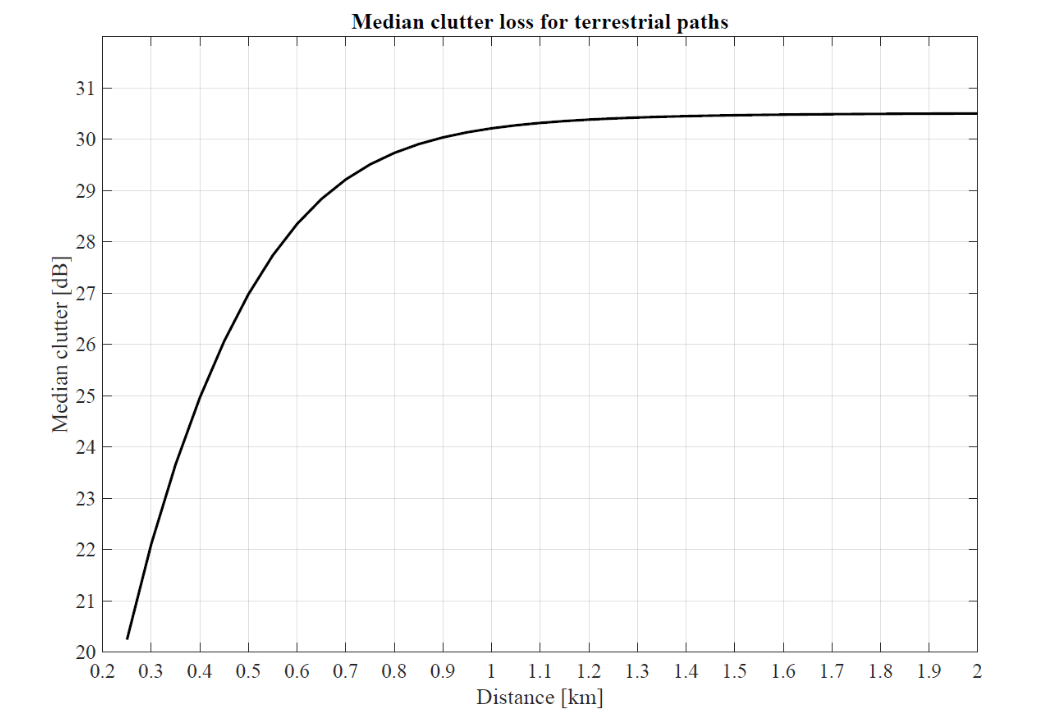
Lctt: The median clutter loss, to be calculated by Equation xx and is limited by Statements yy and zz.
$$L_{ctt}(dB) = 15\log(10^{-6.1024} + 10^{-6.9298 - 4.78d})$$
The clutter loss, Lctt shall be limited by the following statements:
$$L_{ctt} \le L_{ctt2km}$$
where Lcc-2km is the value of Lctt at d = 2 km, and
$$L_{ctt} = 0 \ dB \ \text{for} \ d < 0.25 \ km$$
Note: For practical implementation reasons, if the antenna height of a CBSD or a protected entity is lower than 1 meter above the ground level, the antenna height is taken to be 1 meter above the ground level in the ITM model for initial certification.
Note 2: The reference implementation is maintained in the WInnForum code repository.
REL1Ext-R2-SGN-12 Apply the following text deletion (text strike) and addition (in square bracket) to R2-SGN-12 specified in WINNF-TS-0112-V1.9.1:
R2-SGN-12: Aggregate Interference Calculations
REL1Ext-R2-SGN-24: Apply the following text deletion (text strike) and addition (in square bracket) to R2-SGN-124 specified in WINNF-TS-0112-V1.9.1:
R2-SGN-24: DPA Protection Procedure
a. In the case of co-channel frequency range protection for offshore or inland DPAs, for each protection point, p, under consideration within the given DPA and for any co-channel frequency range ch, designate the protection constraint c = <p,ch> and define Nc to be the total number of CBSDs having or requesting a co-channel grant that includes any portion of the frequency range ch, and that are within a neighborhood of protection point p.
For each protection constraint c, the SAS shall determine the Nc CBSDs that are considered to be within the neighborhood of protection constraint <p,ch> in a manner that is substantially similar4 to the following procedure:
The values of R_C_DPAA and R_C_DPAB [ R_C_Out_<=6m_DPAA , R_C_Out_>6m_DPAA , R_C_In_<=6m_DPAA , R_C_In_<=6m_DPAA , R_C_<=6m_DPAB , and R_C_>6m_DPAB] for co-channel in-land and offshore DPAs are captured in DPA KML files determined in [Ref-14].
b. In the case of out-of-band frequency range protection for inland DPAs, for each protection point, p, under consideration within the given DPA and for any protected out-of-band frequency range, ch, designate the protection constraint c = <p,ch> and define Nc to be the total number of CBSDs having or requesting any grant, and that are within a neighborhood of protection point p.
For each protection constraint c, the SAS shall determine the Nc CBSDs that are considered to be within the neighborhood of protection constraint <p,ch> in a manner that is substantially similar5 to the following procedure:
The values of R_O_DPAA and R_O_DPAB for co-channel in-land and offshore DPAs are captured in DPA KML files determined in [Ref-14].
Note: e.g., if the upper edge of ch falls at or below 3530 MHz, the value of -40 dBm/MHz, and if ch falls at or below 3540 MHz but above 3530 MHz, the value of -25 dBm/MHz is assumed for all grants.
See NTIA – ITS Irregular Terrain Model (ITM) (Longley-Rice) ( 20MHz-20 GHz)
Pages