Is CBRS "Good Enough"?
Reflections on Power Limits, Real-World Performance, and Why We Built a Simple Link Profiler
By Jesse Caulfield, CEO, Key Bridge Wireless
April 2026
Last week, I published a post titled "Extremely High-Power CBSDs" explaining why proposals for dramatically higher power levels would break the Citizens Broadband Radio Service (CBRS) ecosystem we've all worked so hard to build.
The argument centered on interference: massive protection areas that would throttle or terminate thousands of co-channel grants, adjacent-channel and blocking interference that current Spectrum Access Systems (SAS) aren't equipped to fully mitigate, and a collapse in the dense spatial reuse that makes CBRS useful.
But something important went mostly unsaid in that piece, even though it was implied throughout:
Current CBRS power limits are good enough.
That's my honest assessment after years of deploying, managing, and optimizing networks in the band. Of course, I am an interested party: My company, Key Bridge Wireless, is deeply involved in CBRS as a SAS administrator and provider of planning tools and technology. So rather than just stating my opinion, I and the Key Bridge team thought it a good idea to give you a transparent way to draw your own conclusion.
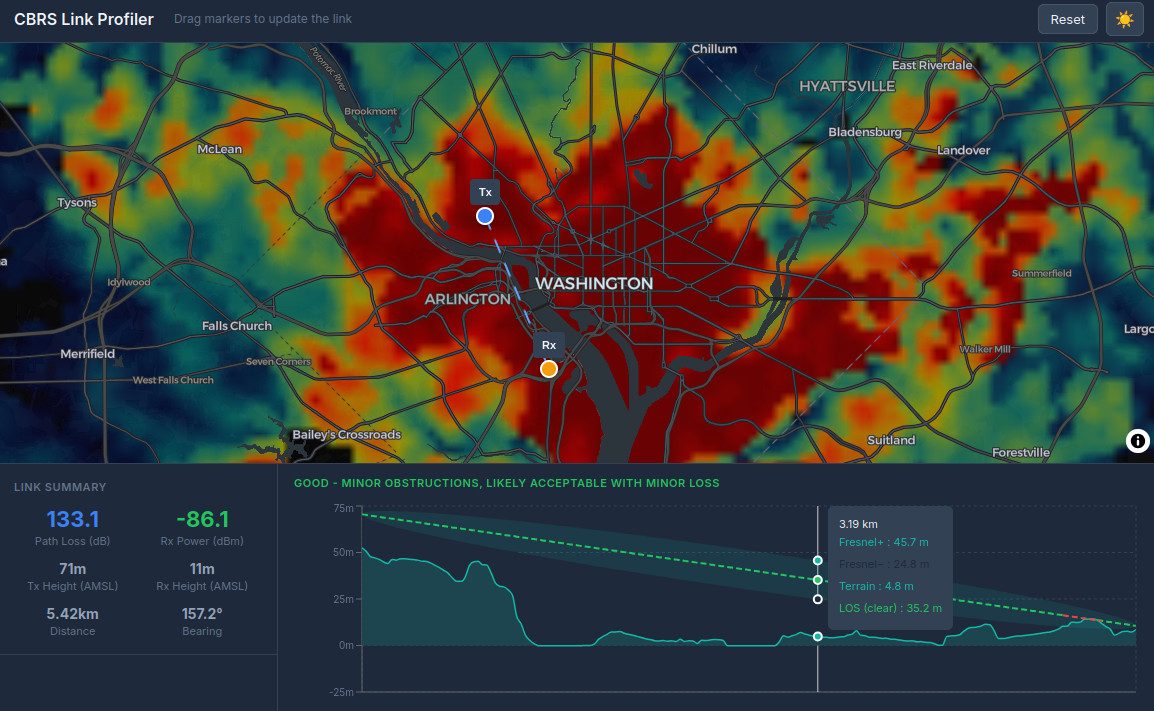
To help operators, enterprises, integrators, and policymakers visualize what "normal" CBRS performance actually looks like, we've created a simple, stripped-down CBRS Link Profiler.
This isn't a full SAS simulation with all the regulatory complexity, incumbent protections, or multi-user interference modeling. It's an intentionally basic tool focused purely on signal propagation for a typical Category B deployment operating at full authorized power.
The tool is free to use and available here: https://app.keybridgewireless.com/profiler/index.html
How to use it:
Configuration (what the tool models):
This setup reflects how most Category B radios are actually deployed and operated in the field: outdoors, professionally installed, running at or near full power because the SAS grants them the headroom and they need it for reliable coverage.
Play with it for a few minutes and you'll quickly see the usable range for solid signal quality in a variety of environments. It demonstrates why the current Category B limits (50 W / 47 dBm per 10 MHz) were thoughtfully engineered: enough power for meaningful coverage in private and localized networks, without the massive footprints that would crowd out neighbors in a shared band.
CBRS was never designed to compete head-to-head with traditional high-power macro cellular spectrum. It was engineered as an innovation band that prioritizes coexistence, spatial reuse, and broad access.
Category A (lower power, often indoor/small cell) and Category B (higher but still constrained) limits were chosen deliberately to enable dense deployments. Nokia's Digital Automation Cloud (DAC) and other private LTE/5G solutions thrive in this environment because they can deliver zero-touch reliability for industrial IoT, automation, video surveillance, and mission-critical communications without stepping on each other.
Our team at Key Bridge has contributed planning, deployment, and tuning tools that help make these networks sing—particularly with partners like Nokia. Over the past decade, we've built spectrum situational awareness capabilities precisely because understanding real propagation, interference potential, and grant dynamics is essential in a shared band.
The proposed "extremely high-power" tiers would flip that model on its head. A handful of macro-style deployments could dominate large geographic areas, expanding PAL Protection Areas dramatically, forcing GAA users off channels, and introducing interference footprints measured in tens or even hundreds of kilometers. Real-world modeling (including studies using actual deployment data from hundreds of thousands of CBSDs) shows throughput collapses, latency spikes, and stranded investments for the very users who made CBRS a success story.
Current limits aren't perfect—no spectrum framework is—but they strike a workable balance. They support reliable links for the use cases that matter most to enterprises and rural providers, while preserving room for thousands of operators to coexist.
This Link Profiler is just one small, free window into our broader toolkit. Key Bridge has been developing advanced spectrum awareness, visualization, and optimization tools for over a decade. Many of these features are already integrated (or will be soon) into our CBRS portal.
No charge, no paywall. If you have (or create) a free account at keybridgewireless.com/cbrs, you can access these capabilities to plan smarter, monitor grants more effectively, and tune your deployments with better data.
Whether you're running a private 5G network on a factory floor, delivering fixed wireless in a rural community, or simply evaluating CBRS for a new project, the goal is the same: make the band work reliably in the real world.
Is CBRS good enough today? In my view: Yes, it is. The existing Category A and B power limits deliver practical coverage and capacity for the over 430,000 devices. Pushing far beyond those limits risks turning a shared innovation band into something much closer to traditional exclusive macro spectrum, at the expense of the very diversity and competition that made CBRS unique.
Reach out if you're interested in exploring the full suite of tools in our CBRS portal. And if you're concerned about the high-power proposals, consider making your voice heard in the ongoing FCC proceeding.
The band we've helped build is working. Let's keep it that way.
Jesse Caulfield
CEO, Key Bridge Wireless
Pages