Protecting Critical Radar Operations While Enabling Commercial Innovation
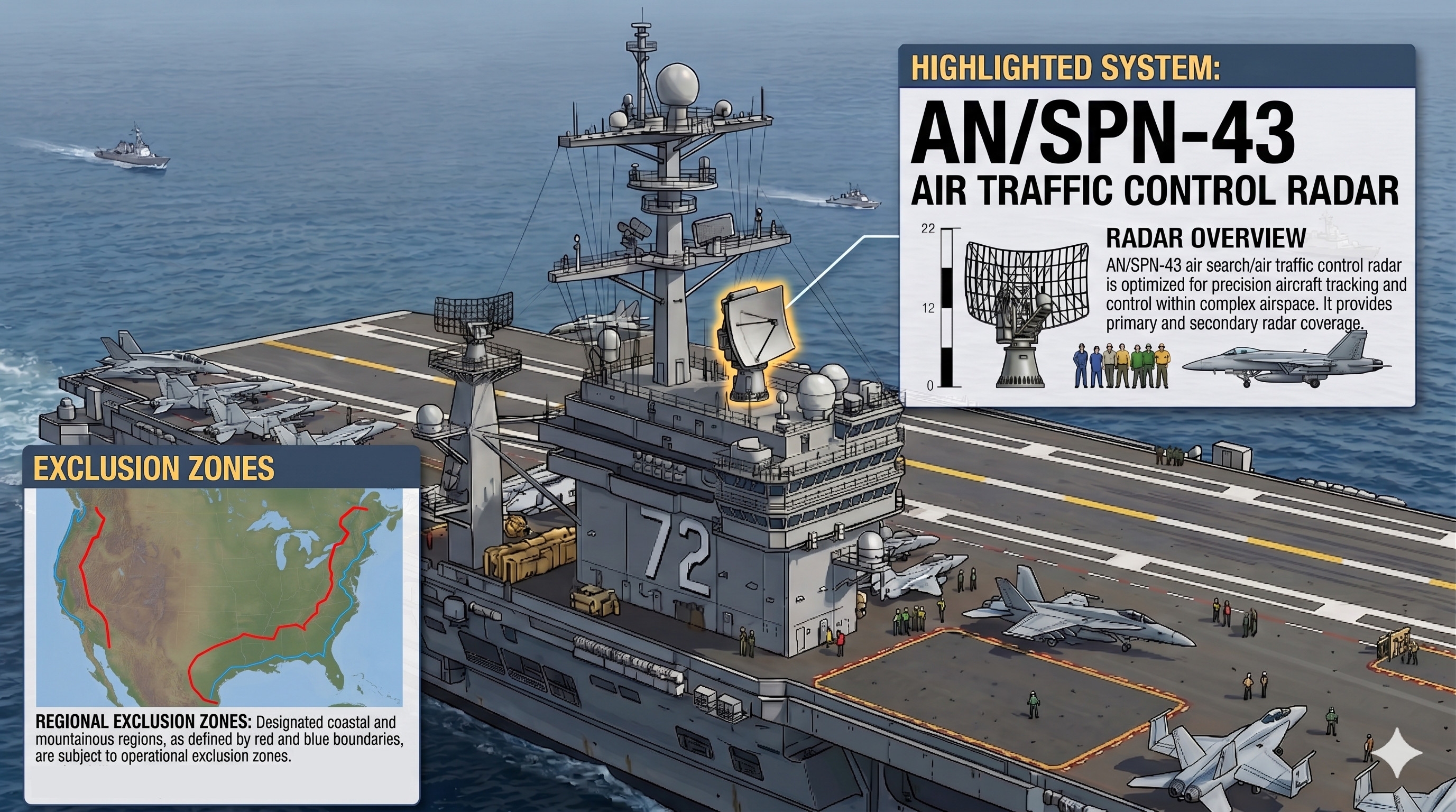
The AN/SPN-43 is an S-band 2D air traffic control radar deployed aboard U.S. Navy aircraft carriers and amphibious ships. It provides essential azimuth and range data for safe aircraft control, identification, and guidance—extending out to at least 50 nautical miles, from the radar horizon up to 30,000 feet. This is true safety-of-life equipment: it helps get planes aboard the ship safely in all conditions.
While the SPN-43 is the most prominent unclassified federal system operating in the 3.5 GHz band, it represents a broader set of challenges in spectrum sharing. The Citizens Broadband Radio Service (CBRS) in the 3550–3700 MHz range must coexist with these critical military radars without causing degradation. CBRS deployments, operating 24/7, introduce a unique technical consideration.
From a radar’s perspective, continuous CBRS transmissions can appear as interference—effectively “de-tuning” returns and making aircraft blips harder to discern reliably amid the noise. That’s why, back in 2015, the U.S. Navy and the National Telecommunications and Information Administration (NTIA) initially called for coastal exclusion zones where CBRS operations would be restricted.
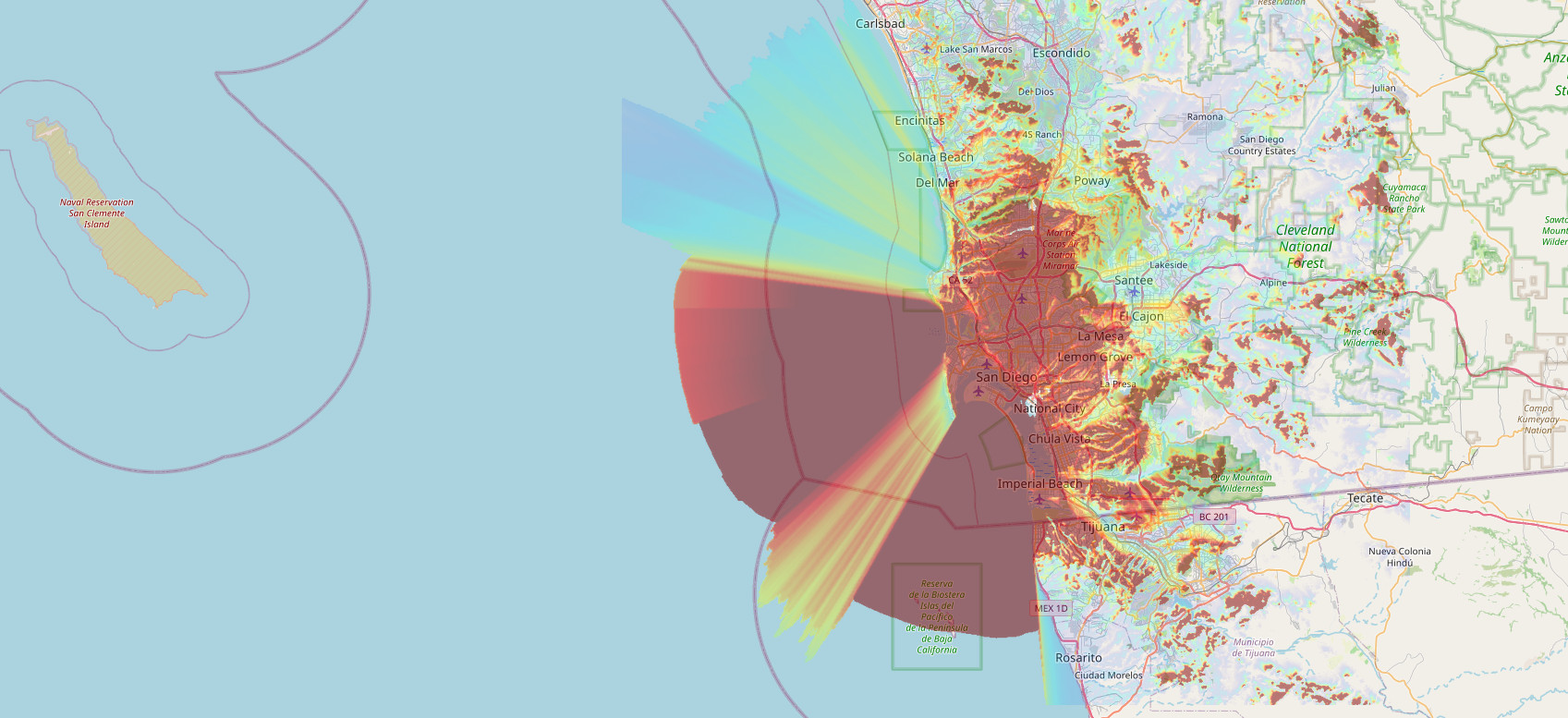
First-pass models show that the new ultra-high power proposals would create enormous macro-cells with areas more resembling an FM radio station than a cellular network. The colored lobes illustrate how far a single high-power Category-D CBSD could propagate — well beyond the horizon in many directions — dramatically increasing the potential for co-channel interference with shipborne radars operating far offshore.
What followed was five years of intensive, good-faith technical negotiations involving all branches of the U.S. military (led by the Pentagon Chief Information Officer), NTIA, the Federal Communications Commission (FCC), and industry stakeholders. I had the privilege of participating from day one, representing Key Bridge.
The outcome is a pragmatic, field-tested, and dynamic spectrum-sharing framework that remains one of the most innovative in the world:
Recent advancements in CBRS 2.0 have dramatically reduced the size of Dynamic Protection Areas (DPAs). This means significantly more consistent access for commercial users—especially indoors—while maintaining robust safeguards for military operations. Protection zones have shrunk, unlocking greater spectrum availability along the coasts without compromising national security.
The U.S. military trains as it fights. Carrier strike group operations often position the ship 50–100 miles offshore—close enough for rapid response if needed, yet far enough to minimize disruption to coastal communities. However, the signal propagation of ultra-high-power CBRS systems, especially beyond the horizon, would require a complete revisit of CBRS spectrum sharing models to avoid pushing those training areas even farther out.
This is not a hypothetical engineering concern. It directly affects operational realism, readiness, and the delicate balance between commercial innovation and military effectiveness.
Spectrum sharing done right—balancing innovation with national security and public safety—is hard, technical work. But it’s possible when stakeholders engage constructively.
The CBRS framework proves this point. Through iterative collaboration, we moved from large static exclusion zones to dynamic, data-driven protections that adapt in real time. CBRS 2.0 further refines this model with more accurate propagation modeling, reduced preemption risks (now leaving ~97% of the continental U.S. largely unencumbered), and improved performance for both indoor and outdoor deployments.
This approach delivers tangible wins:
As demand for spectrum continues to grow—for everything from advanced wireless broadband to next-generation defense systems—successful models like CBRS offer a blueprint. They show that we don’t have to choose between innovation and security. We can achieve both through rigorous engineering, transparent stakeholder engagement, and adaptive policy.
The journey from 2015’s initial concerns to today’s operational success demonstrates what’s possible when technical experts, regulators, and industry work together with shared respect for each mission.
References:
Pages