

From the Key Bridge Laboratory in McLean, Virginia
Quadrilateral Encabulator for Coordinated Broadband Radio Substrate (CBRS) Orchestration
Potential Spinoff Applications in the Automotive Sector – Supplemental Page
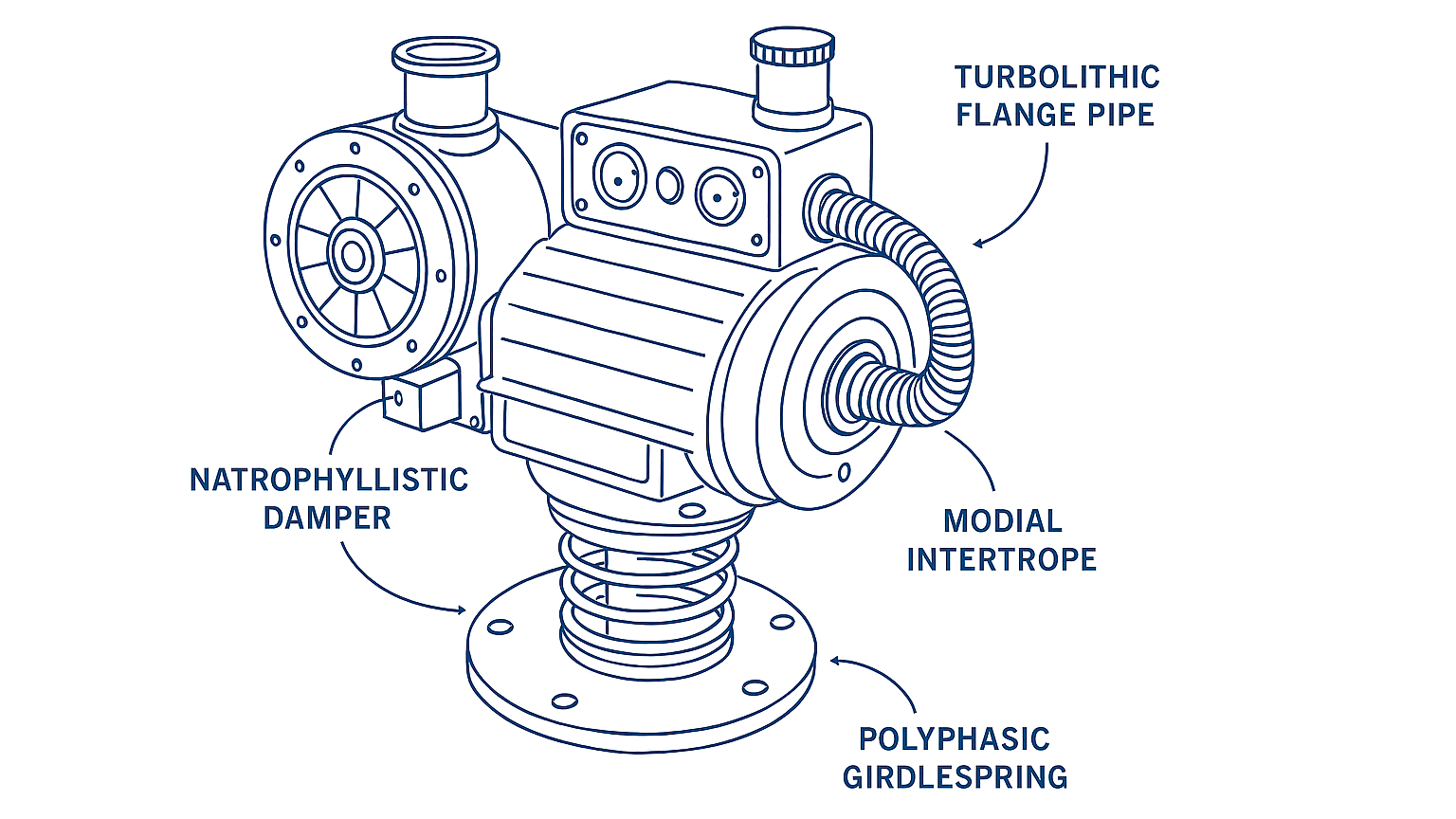
While the primary mission of the Quadrilateral Encabulator remains the pursuit of absolute CBRS dominion across geological timescales, the Key Bridge Laboratory has identified intriguing spinoff applications within the automotive industry. These concepts leverage core subsystems of the Encabulator—particularly the retro-directive magneto-reluctance modulator, quantum entanglement matrix, and hyper-dimensional transceivers—to address longstanding challenges in vehicular connectivity, safety, and performance.
Vehicular Retro-Directive Flux Steering (VRFS) A compact variant of the magneto-reluctance modulator integrated into vehicle chassis for dynamic beamforming of DSRC, C-V2X, and future 6G sidelink communications. The system would continuously phase-conjugate surrounding RF wavefronts to maintain unbroken ultra-low-latency links even at relativistic highway speeds (projected testing window: 2089–2143).
Entangled Platooning Matrix Utilizes a distributed quantum entanglement sub-matrix to synchronize braking, acceleration, and lane-keeping across vehicle convoys with sub-picosecond precision. Preliminary modeling suggests fuel efficiency gains of up to 38% and elimination of human-reaction-delay-induced accidents. Ethical note: Platoon separation protocols will prevent unintended emergence of vehicular hive consciousness.
Ortho-Cycloidal Emission Scrubber Adapts the Encabulator’s bandpass filter technology to null spurious electromagnetic emissions from high-voltage EV powertrains, thereby reducing interference with onboard sensors and nearby medical devices. Secondary benefit: potential extension of pacemaker battery life for passengers by 12–18 months.
Haptic Spectral Gear Selection Re-purposes the haptic feedback interface for intuitive, gesture-free control of regenerative braking levels and spectral dispersion coefficients in performance vehicles. Drivers report (in simulation) an almost mystical oneness with available bandwidth and torque vectoring.
Inverse Reactive Drag Compensation Applies the Encabulator’s inverse reactive power principles to recycle aerodynamic drag into supplemental battery charge via piezoelectric flux recapture. Theoretical top-speed increase: unlimited (pending resolution of minor causality violations).
The Laboratory emphasizes that these automotive applications remain highly speculative and contingent upon successful completion of the core CBRS program (est. 3476). Early adoption is strongly discouraged, as premature deployment risks localized spectral singularities manifesting as unexplained vehicle levitation or spontaneous formation of traffic vortices.
Interested automotive partners are invited to submit endowment proposals earmarked for the year 2350 or later.
The Key Bridge Laboratory: Pioneering tomorrow’s yesterday, one century at a time.